
Agentic Recruiting: What It Means When Your Sourcing Tool Can Book Interviews on Its Own
Most sourcing tools stop at the search. They surface a list of names, hand you a spreadsheet, and leave the rest to you. You still write the messages, manage the follow-ups, coordinate calendars, and chase replies across four different platforms. The tool did the easy part. You did the work.
- What "Agentic" Actually Means in Recruiting
- Why Sourcing Alone Is No Longer Enough
- What Agentic Recruiting Looks Like in Practice
- The Multi-Channel Piece Is More Important Than It Sounds
- What Agentic Recruiting Means for Recruiters Day to Day
- What to Watch For When Evaluating Agentic Tools
- Where Agentic Recruiting Is Headed
- Frequently Asked Questions
What "Agentic" Actually Means in Recruiting
The word gets thrown around loosely, so it is worth being precise. An agentic system does not just respond to a prompt. It pursues a goal across multiple steps, adapts based on what happens, and takes action autonomously until the objective is complete.
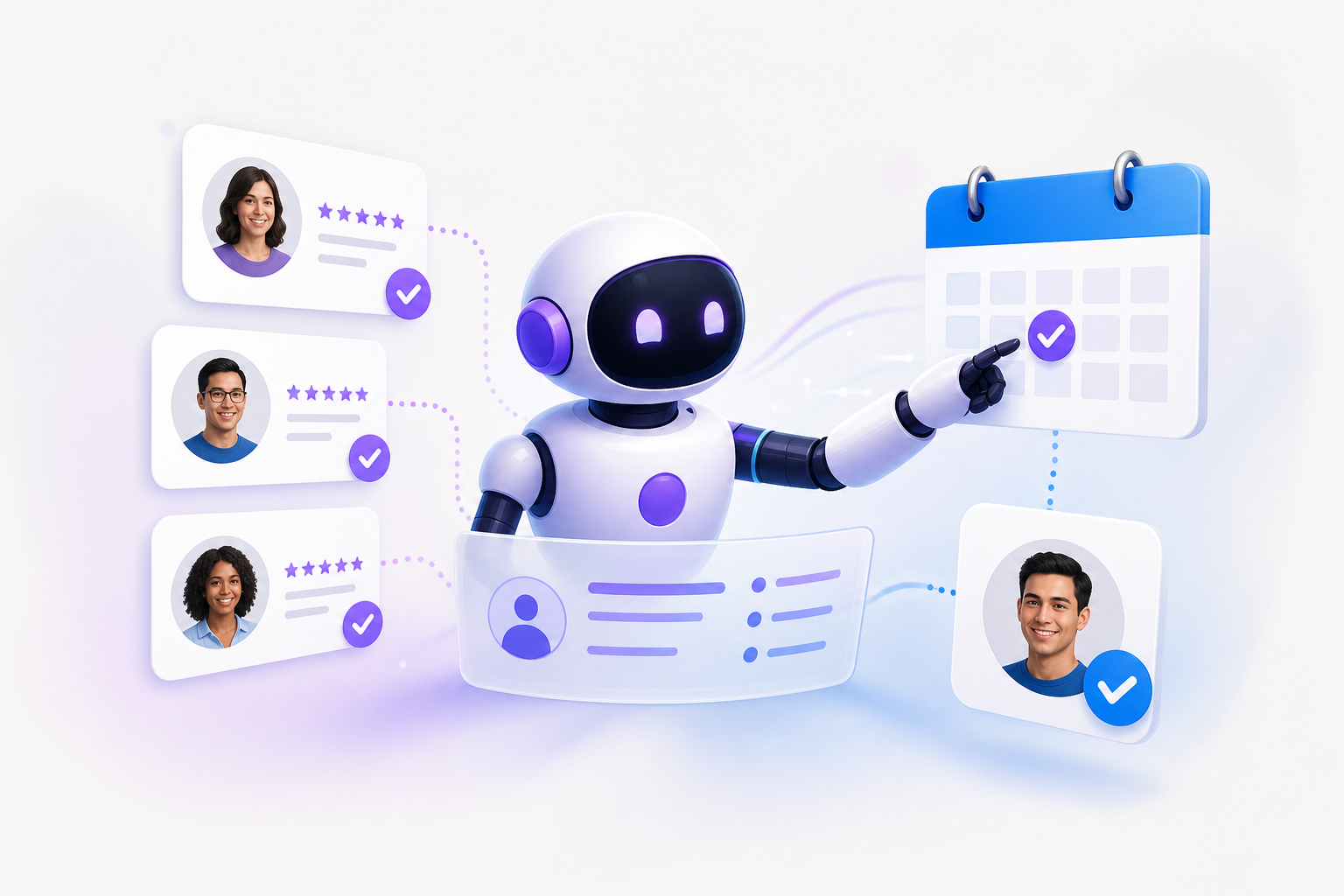
With a traditional AI sourcing tool, you type a search, get results, and take over from there. With an agentic recruiting tool, you describe what you need and the system handles the rest: identifying candidates, enriching contact data, reaching out across the right channels, following up when there is no reply, and booking a call when someone responds positively.
That difference is not cosmetic. Traditional automation executes a fixed sequence of steps you define in advance. An agentic system makes decisions mid-workflow — it reads a candidate's reply, determines whether it signals interest, and decides what to do next. That kind of adaptive execution is what separates a genuine agent from a fancy macro.
It also matters because the bottleneck in recruiting has never really been finding candidates. It has been everything that happens after you find them.
Why Sourcing Alone Is No Longer Enough
Think about what a typical sourcing workflow actually looks like. A recruiter builds a Boolean search or filters through a database, exports a list, manually verifies contact details, drafts outreach, sends it via LinkedIn or email, waits, follows up, waits again, then tries to find a time to talk.
Repeated across dozens of roles and hundreds of candidates, that cycle consumes an enormous amount of recruiter time — and most of it is not strategic work. It is coordination overhead.
The problem compounds when you are managing five to ten open roles at once without a dedicated sourcing team. Each role has its own pipeline, its own outreach thread, its own follow-up schedule. Keeping all of that moving without dropping candidates through the cracks is a full-time job before you have run a single interview.
Agentic tools target exactly that overhead. They do not just reduce time spent searching — they compress the entire sourcing-to-interview cycle by handling the coordination layer that currently lives in a recruiter's inbox, calendar, and mental to-do list.
What Agentic Recruiting Looks Like in Practice
A recruiter types a natural-language prompt: "Find me a senior backend engineer in Berlin with Go experience, a fintech background, and open to hybrid roles." An agentic system does not just return a ranked list. It matches that description against a large profile database, surfaces candidates with verified contact details, and begins outreach across LinkedIn, email, SMS, or WhatsApp — without the recruiter manually drafting each message.
When a candidate replies, the agent handles the conversation. When they express interest, it books the interview directly onto the recruiter's calendar. The recruiter's first real touchpoint might be the scheduled call itself.
That is the workflow Kalent is built around. The platform takes a natural-language description of an ideal candidate, matches it against 200M+ profiles across Europe and the US, and runs a multi-channel conversational agent that handles outreach and scheduling as a single connected workflow — not separate tools stitched together.
The Contact Data Problem Most Tools Ignore
One reason agentic workflows break down in practice is bad contact data. An agent can write a perfect outreach message, but if the email bounces and there is no phone number, the workflow stalls. You are back to manual enrichment.
Contact coverage is not a minor detail. Kalent returns profiles with approximately 80% mobile phone number and email coverage, which means the agent has real contact points to work with on most candidates it surfaces. That is what allows the outreach step to run without human intervention — the data is there when the agent needs it.
What the Conversation Layer Actually Does
The "conversational" part of agentic recruiting is worth unpacking. The agent is not blasting templates. It is having back-and-forth exchanges: answering basic questions about the role, qualifying interest, handling objections, and moving candidates toward a scheduled call.
That is a different capability than bulk email automation. Bulk automation sends a sequence and stops when someone does not reply. A conversational agent reads the reply, interprets intent, and responds accordingly. If a candidate says they are interested but traveling next week, the agent can acknowledge that and suggest times for the week after. If they ask about remote flexibility, the agent can address it before the recruiter is ever involved.
This is what makes interview booking possible without a human in the loop. The agent does not just collect replies — it moves candidates through a qualification and scheduling flow.
The Multi-Channel Piece Is More Important Than It Sounds
One reason agentic recruiting tools can actually close the loop on scheduling is that they are not limited to a single outreach channel. Candidates do not all respond to LinkedIn messages. Some prefer email. Some are more reachable on WhatsApp. Some need a text.
A system that can only reach out via one channel will hit a response ceiling quickly. An agent that sequences across LinkedIn, email, SMS, and WhatsApp — and adapts based on where engagement actually happens — gets a meaningfully higher share of candidates into conversation. More conversations means more interviews booked.
This is also where the European market creates a specific challenge. Outreach norms differ significantly across France, Germany, the Netherlands, and the UK. WhatsApp is a primary communication channel in parts of Southern Europe in a way it simply is not in the US. An agent limited to LinkedIn InMail and email is not well-suited for a pan-European search.
Kalent's outreach agent covers LinkedIn, email, SMS, and WhatsApp natively. That four-channel capability is available on the Copilot plan, which is designed for recruiters who need the full sourcing-to-interview workflow rather than just the search layer.
What Agentic Recruiting Means for Recruiters Day to Day
Agentic recruiting does not replace recruiters. It changes what they spend their time on.
Right now, a significant portion of recruiting work is administrative: building sourcing lists, writing outreach, managing follow-up sequences, coordinating availability. An agentic tool handles most of that. What remains is higher-value work — evaluating candidates who have already expressed interest, running interviews, making hiring decisions, and building relationships with hiring managers.
That is a better use of a recruiter's skills. It is also a faster experience for candidates, who get timely outreach and quick scheduling rather than waiting weeks to hear back.
For teams managing high-volume hiring or running searches across multiple roles simultaneously, the leverage is especially significant. An agent does not slow down when you add more requisitions. It scales in a way a small team simply cannot.
What Changes for Agency Recruiters
For agency recruiters managing multiple client mandates at once, the shift is even more pronounced. Each mandate has its own candidate pool, its own outreach cadence, its own scheduling logistics. Managing that manually across five or ten active searches is the kind of work that creates burnout and missed deadlines.
An agentic platform handles the parallel execution. The recruiter sets the parameters for each search, and the agent runs outreach and qualification workflows simultaneously. The recruiter reviews interested candidates and runs interviews rather than spending the day writing messages and chasing replies.
What to Watch For When Evaluating Agentic Tools
Not every tool that claims to be "agentic" actually is. A few things are worth examining before committing to a platform.
Does it actually take action, or just suggest actions? Some tools flag candidates and draft messages but still require you to hit send. That is assisted automation, not agentic behavior. A genuine agent executes outreach, follows up, and books interviews without waiting for approval at each step.
How many channels does it cover? A tool that is email-only or LinkedIn-only is not running a full agentic workflow. Candidates go dark on one channel and respond on another. If the agent cannot follow them across channels, the workflow breaks.
What happens when the data is wrong? If the platform returns profiles with low contact coverage, the agent stalls at the outreach step. Ask specifically about mobile number and email hit rates before assuming the agent can run autonomously.
Is the outreach native or bolted on? Some platforms source candidates in one tool and push them to a separate outreach platform via integration. That is better than fully manual, but it introduces failure points and means paying for two tools. A platform where sourcing, enrichment, and outreach live in the same workflow is more reliable and easier to manage.
What does it do when a candidate replies outside business hours? A real agentic system handles replies whenever they come in. If the agent only processes responses during a sync window, you are losing response speed — which is one of the main reasons to use an agent in the first place.
Where Agentic Recruiting Is Headed
The current generation of agentic recruiting tools handles the sourcing-to-interview cycle. The next generation will extend further in both directions.
On the front end, agents will take on more of the role scoping work — synthesizing hiring manager input, past successful hires, and market data to build candidate profiles without the recruiter defining every parameter. On the back end, they will handle more post-interview coordination: collecting feedback, managing offer logistics, and maintaining candidate relationships for future roles.
The underlying shift is that recruiting workflows are becoming goal-oriented rather than step-oriented. Instead of configuring a sequence of tasks, you describe an outcome and the system figures out how to get there. That is a different relationship between the recruiter and their tools — and it is already underway in the platforms being built today.
For recruiters evaluating tools in 2026, the practical question is not whether to adopt agentic capabilities. It is which platform gives you the most complete workflow without requiring you to stitch together separate sourcing, enrichment, and outreach tools. The more of that coordination the platform handles natively, the more of your time stays on the work that actually requires a human.
Frequently Asked Questions
What is agentic recruiting?
Agentic recruiting refers to AI systems that pursue hiring goals autonomously across multiple steps — finding candidates, enriching contact data, running outreach, handling replies, and scheduling interviews — without requiring a recruiter to manage each action individually. The key distinction from standard automation is adaptive execution: the agent responds to what happens and adjusts its behavior accordingly.
How is an agentic recruiting tool different from a standard sourcing tool?
A standard sourcing tool returns a list of candidates and stops there. An agentic recruiting tool continues the workflow: it reaches out to candidates, manages the conversation, and books interviews. The recruiter's role shifts from executing the workflow to reviewing the output of candidates who have already expressed interest.
Can an agentic tool really book interviews without human involvement?
Yes, when the underlying data and conversation layer are solid. The agent needs verified contact details to reach candidates, multi-channel outreach capability to get replies, and a conversational layer that can qualify interest and coordinate scheduling. When those components are in place, the agent can take a candidate from first contact to calendar invite without the recruiter intervening.
What outreach channels do agentic recruiting tools use?
The most capable platforms cover LinkedIn, email, SMS, and WhatsApp. Tools limited to one or two channels will miss candidates who are more responsive elsewhere. For European searches in particular, WhatsApp coverage matters given how widely it is used as a primary communication channel in several markets.
Does agentic recruiting work for European candidate searches?
It depends on the platform's data coverage. Most agentic recruiting tools are built around US-centric databases, which limits their usefulness for European hiring. Platforms with explicit European profile coverage and multi-channel outreach that includes WhatsApp are better suited for pan-European searches.
Will agentic recruiting replace recruiters?
No. It shifts what recruiters spend their time on. Administrative work — sourcing, outreach, follow-up, scheduling — moves to the agent. Recruiters focus on evaluating interested candidates, running interviews, making hiring decisions, and managing hiring manager relationships. The work that requires human judgment stays with the human.
What should I look for when evaluating an agentic recruiting platform?
Look for genuine autonomous execution rather than assisted automation, multi-channel outreach coverage, high contact data hit rates, and a native workflow where sourcing and outreach live in the same platform. Also check whether the platform has meaningful profile coverage in the geographies you hire in — a large database skewed toward one region is not useful for global or European searches.
