
Kalent vs. Findem: Deep Dive on Candidate Intelligence and European Data Coverage
If you're evaluating Findem as your next talent intelligence platform, you've probably already run into the friction: enterprise-only contracts, a complex onboarding process, and pricing that puts real strain on lean recruiting teams. The question most recruiters end up asking isn't "is Findem good?" — it's "is Findem built for teams like mine?"
- What Findem Actually Does
- How Kalent Approaches Candidate Intelligence
- European Data Coverage: A Real Differentiator
- Side-by-Side: Where Each Platform Fits
- Who Should Use Findem
- Who Should Use Kalent
- Quick Comparison Table
- FAQs
- The Bottom Line
What Findem Actually Does
Findem is an attribute-based talent intelligence platform. Rather than keyword or Boolean search, it lets you build candidate profiles using structured attributes — things like years at a specific company type, career trajectory patterns, or skill combinations over time. The idea is to surface candidates who match a profile pattern, not just a job description.
For large enterprise TA teams that need to analyze talent pools at scale, run competitive workforce intelligence, or build long-horizon pipelines for executive roles, that's a genuinely compelling approach.
The tradeoff is significant. Findem is estimated at around $6,000 per seat per year, requires a formal sales process, and carries onboarding complexity that assumes dedicated TA operations resources. For a recruiter running 10 hires per quarter at a 100-person company, that's a lot of overhead before you've sent a single outreach message.
How Kalent Approaches Candidate Intelligence
Kalent starts from a different place entirely. Instead of building structured attribute queries, you describe your ideal candidate in plain language. The platform matches that description against a database of 200 million or more profiles covering Europe and the United States, then returns enriched profiles with AI-generated summaries and verified contact details.
The enrichment layer targets approximately 80 percent mobile phone number and email coverage — meaning the profiles you receive aren't just names and job titles. They come with actionable contact data, ready for outreach.
From there, Kalent's conversational outreach agent handles candidate engagement across LinkedIn, email, SMS, and WhatsApp, all within the same workflow. The design intent is to move from a natural-language search to a booked interview without switching tools.
This reflects a meaningfully different philosophy from Findem. Kalent is built around speed and workflow compression. Findem is built around deep talent analytics and attribute modeling. Which one fits depends heavily on where your sourcing process is actually breaking down.
European Data Coverage: A Real Differentiator
This is where the comparison gets specific — and important.
Findem's platform is primarily optimized for US talent markets. If you're sourcing engineers in Berlin, sales leaders in Paris, or operations managers in Amsterdam, the quality of attribute-based matching depends entirely on the underlying European profile data. That quality is not a stated strength of Findem's positioning.
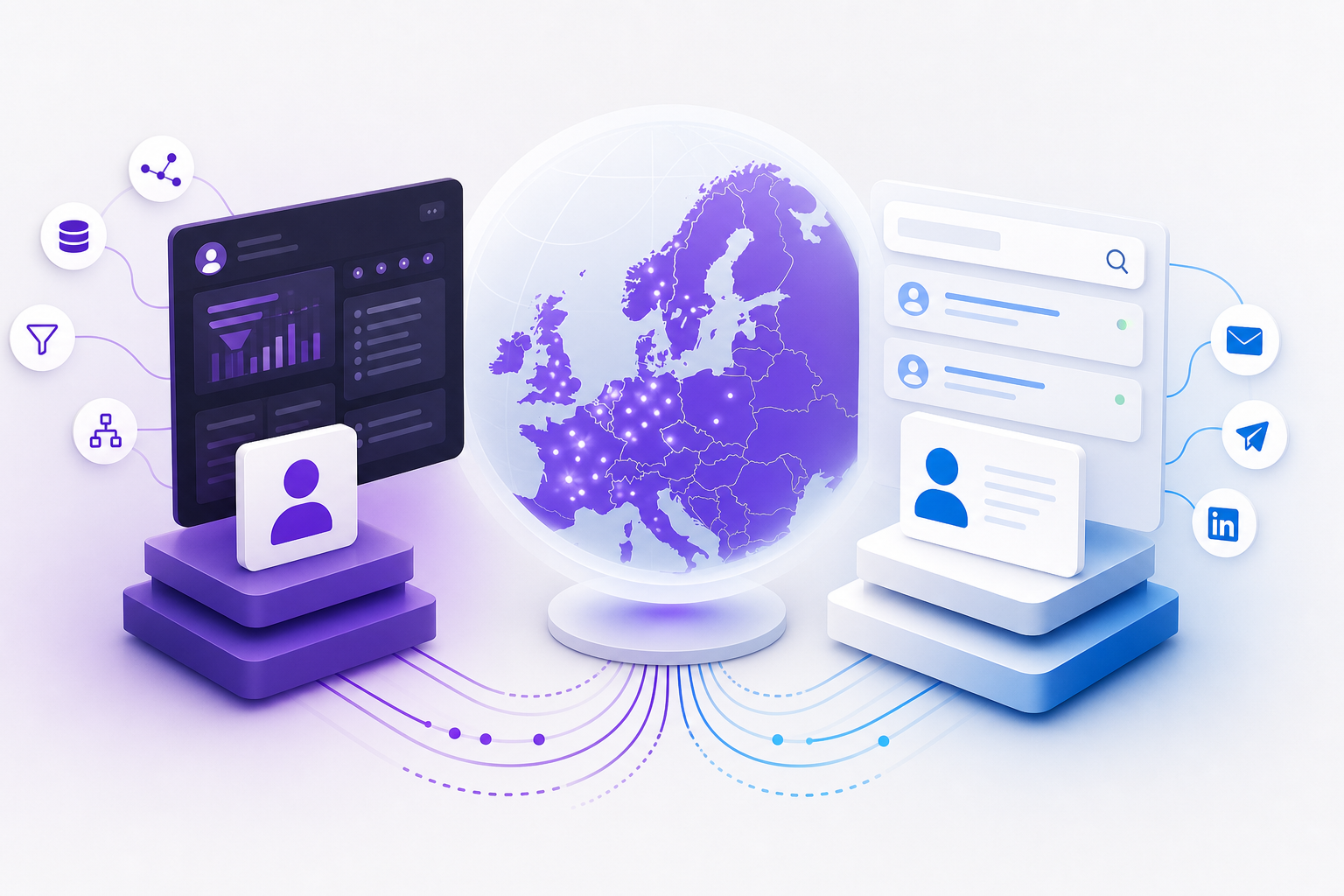
Kalent explicitly covers Europe and the United States across its 200 million-plus profile database. For recruiting teams operating in France, Germany, the Benelux region, or across the EU more broadly, this isn't a minor footnote — it's the difference between a tool that works for your market and one that technically supports it but underperforms in practice.
That distinction matters especially for agency recruiters managing mandates across multiple European markets, or for in-house TA teams at scale-ups expanding from a European headquarters into new geographies.
Side-by-Side: Where Each Platform Fits
Search and Discovery
Findem uses structured attribute queries, which require familiarity with the platform's data model and some ramp-up time to use effectively. The payoff is nuanced talent pool analysis.
Kalent uses natural-language input. You describe what you need, and the platform interprets the intent — no query syntax to learn. For recruiters who want fast candidate discovery without becoming power users of a complex interface, that's a practical advantage.
Outreach and Engagement
Findem doesn't natively automate outreach across multiple channels. After you identify candidates, engagement typically requires separate tools.
Kalent's Copilot plan includes native outreach across LinkedIn, email, SMS, and WhatsApp from within the same platform. This matters because fragmented tooling is one of the most common complaints among sourcing teams: find candidates in one tool, enrich in another, sequence in a third, track in a fourth. Kalent is designed to collapse that stack.
Pricing and Accessibility
Findem is enterprise-only, with pricing estimated at around $6,000 per seat per year and no self-serve option. Getting access requires a sales conversation, and onboarding is described as complex.
Kalent offers transparent, self-serve pricing starting at $119 per month billed annually for the Sourcing plan. The Copilot plan — which adds multi-channel outreach — is $149 per month billed annually. A Team plan with custom pricing covers multi-user access, ATS integration as a paid add-on, and volume discounts. For teams with a budget tolerance in the hundreds rather than thousands per month, the difference is hard to ignore.
ATS and Workflow Integration
Kalent supports 50 or more ATS integrations, available as a paid add-on. A Claude MCP integration — also a paid add-on — connects Kalent's profile data to Anthropic's Claude model via the Model Context Protocol, for teams building AI-augmented recruiting workflows.
Findem has its own enterprise integrations, but the overall implementation complexity is higher.
Who Should Use Findem
Findem makes sense if you're running a large enterprise TA function with dedicated sourcing operations staff, a need for competitive workforce intelligence, and the budget and patience for a structured onboarding process. If your primary use case is analyzing talent pool composition or building attribute-based talent maps for executive hiring, the platform's approach has real merit.
It's not a practical fit for lean recruiting teams, agency recruiters, or scale-ups that need to move quickly and keep tooling costs manageable.
Who Should Use Kalent
Kalent is built for recruiters who need to find and engage candidates fast, without managing a fragmented tool stack. Natural-language search removes the learning curve. Enriched contact data means you're not burning time on manual lookups. Native multi-channel outreach means LinkedIn, email, SMS, and WhatsApp sequences all run from the same place you ran your search.
It's particularly well-suited to teams sourcing in European markets, where Kalent's database coverage is an explicit strength. Named customers including Randstad, Vinci, and Generali reflect that the platform serves both large recruiting organizations and leaner teams.
If you're currently hitting LinkedIn InMail caps, juggling enrichment and outreach across separate tools, or watching your sourcing workflow add days to every hire, Kalent is worth a close look.
Quick Comparison Table
| Kalent | Findem | |
|---|---|---|
| Search method | Natural language | Attribute-based structured queries |
| Database size | 200M+ profiles | Not publicly specified |
| European coverage | Explicit strength | Not a stated focus |
| Native outreach channels | LinkedIn, email, SMS, WhatsApp | Not native |
| Contact data enrichment | ~80% mobile and email coverage | Varies |
| Pricing model | Self-serve, from $119/mo (annual) | Enterprise only, ~$6,000/seat/year |
| Onboarding complexity | Low | High |
| ATS integrations | 50+ (add-on) | Enterprise integrations |
| Best for | Scale-ups, agencies, lean TA teams | Large enterprise TA operations |
FAQs
What is the main difference between Kalent and Findem?
Kalent is a natural-language sourcing and multi-channel outreach platform designed for lean recruiting teams, with explicit European database coverage and self-serve pricing. Findem is an enterprise-only, attribute-based talent intelligence platform built for large TA organizations running workforce analytics and structured talent pool research.
Is Kalent a good Findem alternative for smaller recruiting teams?
Yes. Findem's pricing and onboarding complexity make it impractical for most teams under 200 employees. Kalent's self-serve plans start at $119 per month billed annually and are designed for recruiters running 5 to 20 hires per quarter without a dedicated sourcing team.
Does Kalent cover European candidate profiles?
Yes. Kalent's database of 200 million or more profiles explicitly covers Europe and the United States. For teams sourcing in France, Germany, the Benelux region, or other EU markets, that's a meaningful distinction — some platforms technically support those regions but have noticeably thinner data in practice.
Does Findem support multi-channel outreach?
Findem does not natively automate outreach across LinkedIn, email, SMS, and WhatsApp. Kalent's Copilot plan includes all four channels within a single workflow.
How does Kalent handle contact data quality?
Kalent's enrichment layer targets approximately 80 percent mobile phone number and email coverage on enriched profiles. That figure applies to the enrichment layer overall and will vary across individual profiles and markets.
Can Kalent integrate with my existing ATS?
Kalent supports 50 or more ATS integrations, available as a paid add-on. The Team plan also includes a dedicated account manager to help with setup. If you need to confirm compatibility with a specific system, booking a demo through kalent.ai is the fastest way to get a direct answer.
What is Findem's pricing?
Findem is enterprise-only with no self-serve option. Pricing is estimated at approximately $6,000 per seat per year, though exact figures require a direct conversation with their sales team.
The Bottom Line
Findem and Kalent are solving different problems for different buyers. Findem is a deep talent intelligence tool for large enterprise teams with the budget and operational capacity to use it well. Kalent is a sourcing and engagement platform built to compress the time between "I need to hire" and "I have interviews scheduled" — with European data coverage and multi-channel outreach that most alternatives don't match.
If your current sourcing workflow feels like managing too many tools for too little output, explore what Kalent offers before committing to an enterprise contract you'll spend months trying to fully use.
