
AI candidate sourcing: the method that really cuts time to hire
Run a human plus AI pilot to source candidates: cut sourcing time and improve the relevance of your shortlists.

Take a human plus AI approach and launch a small pilot on one or two roles: you will cut sourcing time while improving the relevance of your shortlists. This measured approach, tested over an extended period with precise indicators, avoids false starts. AI sourcing platforms already make it possible to structure this kind of test in real conditions.
In short:
- Launching a small pilot on one or two roles lets you assess the reduction in sourcing time while improving the relevance of shortlists.
- AI sourcing tools should include a semantic engine, GDPR-compliant contact enrichment, automation agents and an ATS integration.
- An effective test should last about twelve weeks, with key indicators such as sourcing time, engagement and conversion rates, and documented governance.
- Compliance with the GDPR and the AI Act requires stronger transparency, real human oversight and precise documentation of processes.
- Collaboration between AI and human intervention improves the fairness of shortlists and ensures a respectful, balanced candidate experience.
Table of contents
- Why AI sourcing is a game changer for recruiters
- The technical building blocks to demand from an AI sourcing tool
- How to launch and run an AI sourcing test in twelve weeks
- GDPR and AI Act compliance: what you need to document
- Reducing bias and improving shortlist quality
- Evidence and concrete use cases at Kalent
- Automating outreach without losing control of your talent pools
- What people underestimate in AI sourcing
- Starting a test with Kalent
- Frequently asked questions
- Sources
Why AI sourcing is a game changer for recruiters
Sourcing time remains the biggest cost item in a recruiting cycle: identifying, qualifying and contacting relevant profiles takes hours that few teams can afford to lose. Above all, AI changes the detection of passive profiles, the people who never apply but fit the role.
Some hires benefit more from this automation than others.
- Technical roles with a low volume of unsolicited applications, where manual search quickly hits its limits.
- Sales roles where the volume of profiles to qualify is high.
- Rare or hard-to-fill roles, where the traditional candidate base is no longer enough.
Processes that combine humans and AI produce fairer candidate lists than AI alone or human search alone, according to a recent empirical study that measures an improvement in fairness after human intervention. There is a flip side: poorly filtered false positives or overly aggressive outreach automation can damage the candidate experience.
The technical building blocks to demand from an AI sourcing tool
Not all sourcing solutions are equal on the technical side. Before choosing, four families of features deserve a close look.
- A semantic search engine able to understand the context of a role, not just exact keywords.
- Contact data enrichment (emails, mobile numbers) that respects the legal bases for collection, a point we detail in the compliance section.
- Automation agents that generate shortlists and ready-to-use multichannel message templates.
- A native integration with your ATS, a browser extension to source from LinkedIn, and an API to connect the tool to your existing stack.
Kalent's talent search engine illustrates this contextual matching logic applied to a base of more than 200 million profiles. On enrichment, partner solutions such as myDid usefully complement candidate monitoring and market signals for recruitment agencies. Before any purchase, a dedicated buyer checklist helps you compare options without getting lost in sales pitches.
How to launch and run an AI sourcing test in twelve weeks
A poorly scoped pilot produces unusable results. The following structure, inspired by recommendations for a controlled rollout in SMEs, limits that risk.
- Define the scope: one or two typical roles, a target candidate volume, quantified goals.
- Configure the tool on these criteria and train the recruiters involved for two to three weeks.
- Run the pilot for six to eight weeks while keeping systematic human validation of shortlists.
- Carry out a fairness audit at thirty days, then a quarterly review comparing results before and after AI.
- Roll out gradually to other roles once the indicators have stabilized.
Three indicators are enough to judge a pilot: sourcing time per role, the engagement rate of contacted candidates and the conversion rate from first contact to interview. Appoint an owner for the pilot's governance, set a review frequency (weekly at first) and keep a complete log of automated actions.
Pro tip: Keep a timestamped record of every human validation of shortlists: it is the most useful piece in the event of an audit or a dispute.
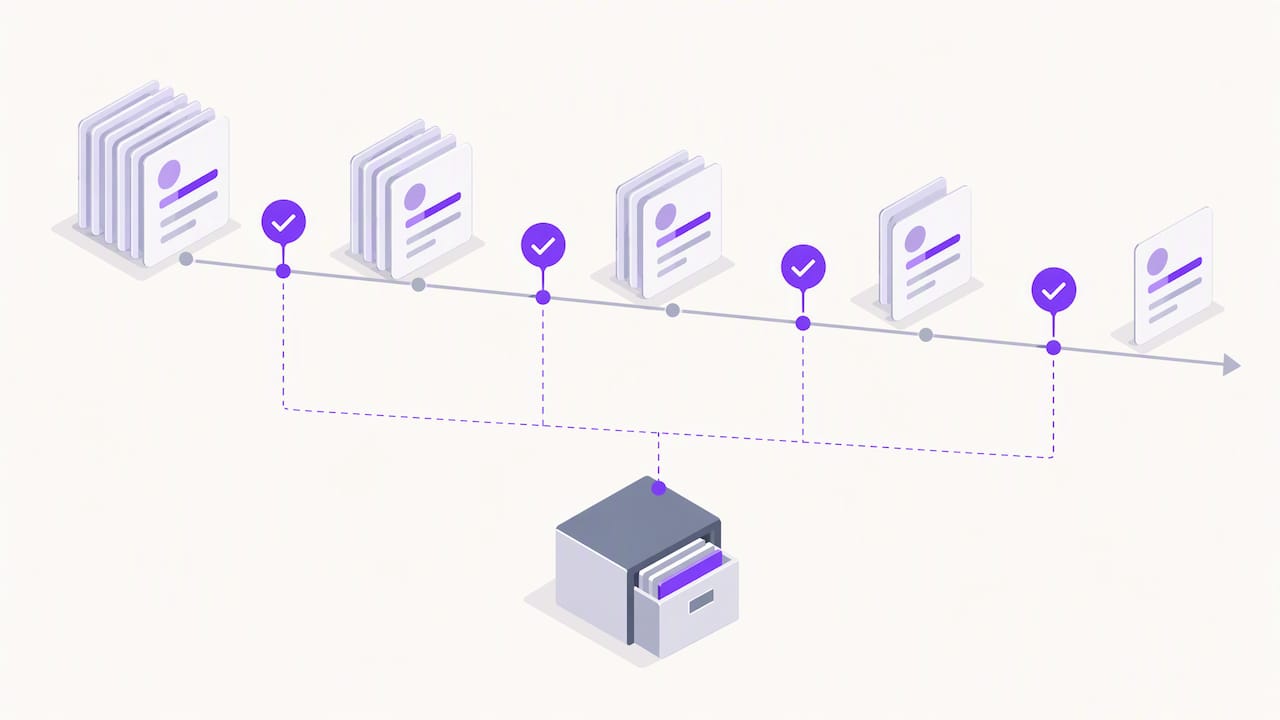
GDPR and AI Act compliance: what you need to document
Recruiting is among the uses the European text regulates most strictly. The AI Act classifies AI systems used for recruiting and selecting people as high-risk systems, in Annex III point 4, which requires transparency, human oversight and documentation.
In practice, this translates into several obligations.
- Clearly inform candidates that an AI system is involved in the sourcing or pre-selection process.
- Guarantee a real right to human intervention, not just a formal one, on every significant decision.
- Keep activity logs and document the criteria used to detect possible discriminatory proxies, as ATIA Avocats points out.
- Carry out a data protection impact assessment before any large-scale rollout.
- Consult the CSE (works council) before the test phase, a step often overlooked but a frequent source of disputes according to Maxey.
This checklist, applied from the pilot's configuration phase, saves you from having to rebuild everything after the fact.
Reducing bias and improving shortlist quality
AI alone guarantees nothing about the fairness of results: it is the combination with structured human oversight that makes the difference. Three practices stand out from the available research.
- Systematically validate and complete the generated shortlists, without accepting them as they are.
- Track fairness metrics (distribution by profile, pre-selection rate) with an audit at least every quarter.
- Provide a clear appeal or opt-out process for candidates who request it.
A conjoint analysis study shows that candidates value the possibility of human intervention, opt-out and appeal as much as the technical accuracy of the system. The procedure often matters as much as the outcome.
Pro tip: Publish a simple internal summary of your fairness audit rules: it makes it easier to get recruiting teams on board and reassures candidates if they ask questions.
Evidence and concrete use cases at Kalent
Our public data helps illustrate what this kind of pilot can produce.
On the technical side, some tools offer ATS connectors and APIs that let you plug automation into an existing pipeline without rewriting the recruiting processes already in place.
Automating outreach without losing control of your talent pools
Sourcing does not stop at identifying the right profiles: outreach often determines the final response rate. Three channels dominate automated sourcing practices today: LinkedIn for the initial approach, email for formal follow-ups, WhatsApp for more direct exchanges with profiles who are already engaged.
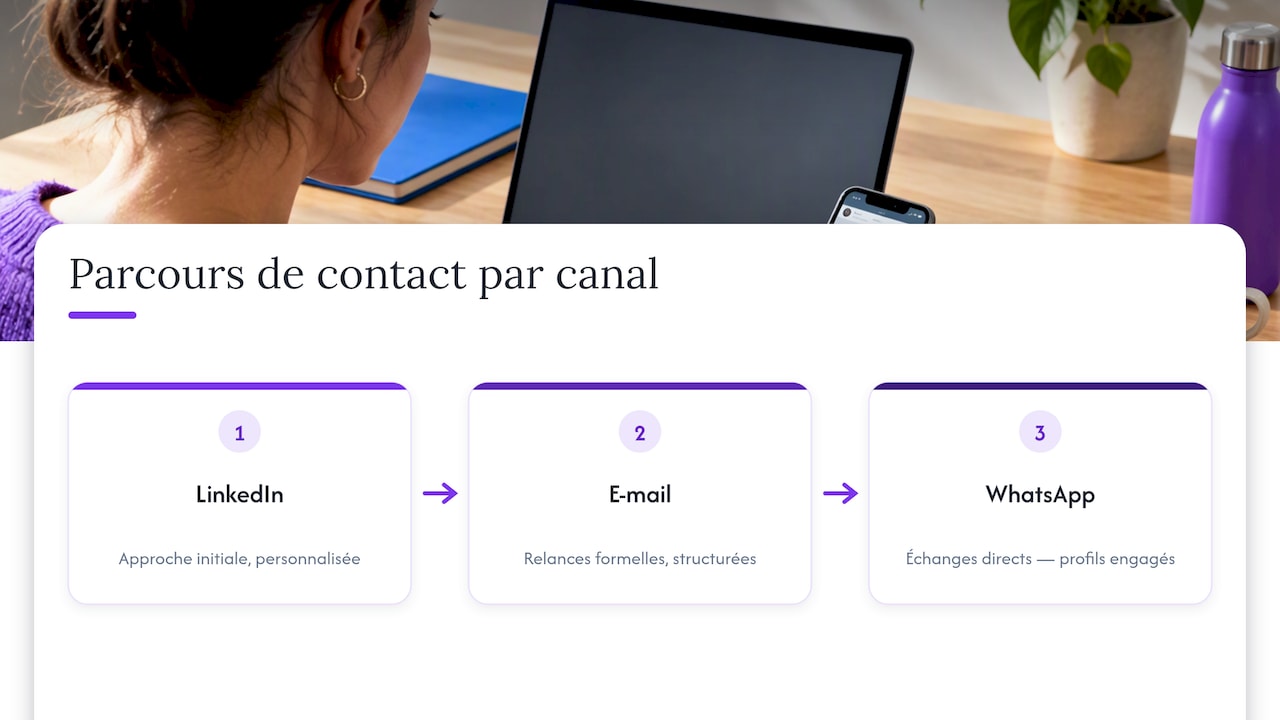
Automating these sequences does not mean making them uniform. A generic message sent at scale generally gets fewer replies than a message personalized according to the channel and the targeted profile. AI sourcing tools that offer message templates adapted to each channel let you keep this personalization while saving time on writing.
Talent pool management deserves particular attention in this context. A candidate contacted without success today may become relevant in six months for another role: keeping a structured history of exchanges, response statuses and reasons for non-conversion avoids awkwardly contacting the same person several times. Regular updates of the candidate base, monthly in some tools, also refresh contact details and prevent high email bounce rates. This groundwork, invisible to candidates, nonetheless determines the credibility of any automated sourcing approach over time.
What people underestimate in AI sourcing
The most common temptation is to judge a sourcing tool on its ability to generate candidate volume. That is the wrong priority. The available data indicates that shortlist quality depends less on raw volume than on the frequency of human validations and the rigor of fairness audits.
The other blind spot is the procedure as candidates experience it. Teams invest heavily in algorithmic precision and too little in communicating how AI actually intervenes in the process. A candidate who understands they can request human intervention or challenge a decision stays engaged, even if the outcome is not in their favor.
Our recommendation remains pragmatic: start small, measure early, document systematically. A well-governed twelve-week pilot is worth more than a poorly prepared massive rollout.
Jules
Starting a test with Kalent
Putting the principles described above into practice (semantic search engine, contact enrichment, multichannel automation and documented governance) requires a tool designed to work this way from the start.
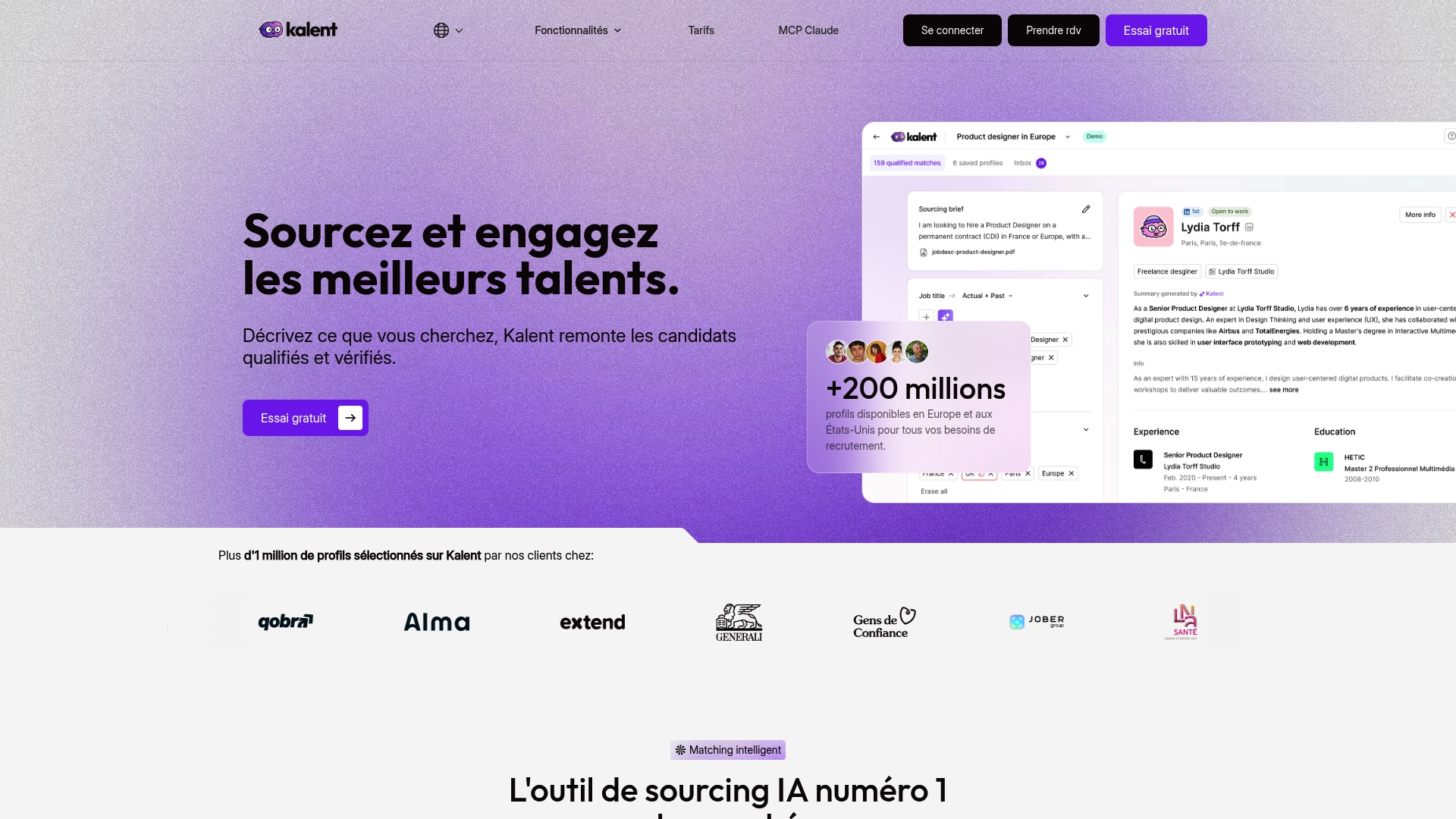
A simple starting point to scope your own pilot:
- Check our pricing page to compare plans based on your hiring volume.
- Request a demo to evaluate the search engine and multichannel automation on your priority roles.
- Structure your test around the compliance checklist presented above, from the configuration phase.
Frequently asked questions
What is AI-assisted candidate sourcing?
Candidate sourcing means identifying and qualifying relevant profiles for a role, whether they are active or passive on the market. When assisted by AI, this process relies on a semantic search engine and automation agents to speed up identification and first contact, while keeping human validation on final decisions.
Which companies use AI to recruit?
Many companies, from SMEs to large groups, integrate AI tools into their recruiting process for sourcing, pre-selection or candidate data enrichment. Some platforms offer this automation, with access to more than 200 million enriched profiles in Europe and the United States.
Will AI replace HR teams?
The available data does not support this scenario: processes combining human intervention and AI produce better fairness outcomes than AI alone, according to a recent study. AI speeds up repetitive sourcing tasks, but validation and the final decision remain human roles.
What are the main types of candidate sourcing?
A distinction is generally made between active sourcing, which means directly approaching identified profiles, and passive sourcing, which spots non-applicant candidates through enriched databases. AI-automated sourcing combines both approaches by broadening profile detection while keeping personalized outreach per channel.
Is an AI sourcing tool compliant with the GDPR and the AI Act?
Compliance depends on how the tool is used, not just on the tool itself: the AI Act classifies recruiting as a high-risk system, which requires transparency and documented human oversight, as explained in this guide for HR companies. A well-designed platform makes compliance easier, but responsibility for informing candidates and consulting the CSE remains with the recruiter.
Sources
- The EU AI Act for HR Tech: What Recruitment, People Analytics, and Workforce AI Companies Need to Know | ActScope
- Human, Algorithm, or Both? Gender Bias in Human-Augmented Recruiting
- AI CV screening in SMEs: what is legal in 2026 | Lumivi


