
Boolean search in recruitment: the method that saves you time
Boolean search speeds up recruitment sourcing: save time, cut false positives and follow a 5-step method.

Boolean search applied to recruitment means combining logical operators (AND, OR, NOT), quotation marks and parentheses to query LinkedIn, Google or a CV database with a precision that a simple keyword search never reaches. It cuts the time spent sorting off-target profiles and improves the relevance of the first results. The following sections cover the operators, ready-to-use query templates, a repeatable five-step method, and the CNIL framework to respect.
In short:
- Boolean search is mainly used to target rare or technical profiles efficiently, especially in external talent pools such as Google or specialized search engines.
- Building an effective query relies on combining the main operators (AND, OR, NOT), quotation marks, parentheses and linguistic variants to maximize the relevance of results.
- The recommended method is to test and refine a query by tightening it progressively, avoiding changing several elements at once so you can measure their impact.
- The CNIL specifies that, even for public data, automated processing must comply with the law by limiting collection and guaranteeing the relevance and security of the data.
- Large-scale automation can complement but never replace manual mastery of Boolean operators for specialized profiles or when volume is limited.
Table of contents
- Why and when to use Boolean search for recruitment sourcing
- The essential operators for building a Boolean query
- Ready-to-use query templates for Google X-Ray and LinkedIn
- How do you build an effective Boolean query in 5 steps?
- Which mistakes should you avoid to iterate efficiently on your queries?
- What are the CNIL rules for candidate sourcing?
- Do you still need to master manual Boolean search in the age of automation?
- Kalent: speed up sourcing without writing a single Boolean query
- Sources
- Frequently asked questions
Why and when to use Boolean search for recruitment sourcing
Not every search deserves a complex Boolean query. For a role that attracts a high volume of applications, an internal search engine is often enough. Boolean logic pays off in specific situations:
- Rare or technical profiles, where every minute spent sorting false positives is costly.
- Roles that require fine filtering on several combined criteria (skill, location, seniority).
- Sourcing in talent pools outside LinkedIn (job boards, general search engines) where the search API is limited.
The efficiency gap between an ATS's internal search engine and an X-Ray search on Google comes down to access: Google indexes public pages that some internal tools do not cover. The practical rule stays simple: start with a broad OR query to capture every variant of the job title, then tighten progressively with AND and NOT until you get a workable list of a few dozen profiles rather than thousands.
The essential operators for building a Boolean query
The foundation rests on three logical building blocks inherited from the work of George Boole, who formalized in the 19th century the binary algebra now used in every search engine.
- AND: requires all terms to be present. Example:
développeur AND React. - OR: broadens the search to synonyms or variants. Example:
(développeur OR developer). - NOT (or
-depending on the engine): excludes an unwanted term. Example:NOT stagiaire. - Quotation marks
" ": lock an exact phrase, useful for a precise job title such as"chef de projet". - Parentheses
( ): group the ORs to avoid ambiguous interpretation. - Asterisk
*: replaces part of a word or an unanticipated spelling variation. - site:: restricts the search to a domain, for example
site:linkedin.com/in. - inurl: and intitle:: target a URL fragment or a page title respectively.
- ext:: filters by file extension, handy for finding CVs in PDF format.
Pro tip: The AND, OR and NOT operators, quotation marks and parentheses form the common base, but their behavior varies from one engine to another: Google tolerates long queries and handles nested parentheses well, LinkedIn interprets some operators differently depending on whether you use the standard search or Recruiter, and Bing remains more permissive with special characters. Rocket4RPO details these syntax differences with useful examples to avoid interpretation errors.
One last point that is often overlooked: synonyms and linguistic variants. A "sales manager" role (« responsable commercial ») also shows up as "business developer", "account manager" or "sales manager" depending on the sector. Without these variants in OR, a technically correct query misses half of the relevant profiles.

Ready-to-use query templates for Google X-Ray and LinkedIn
A template beats an abstract explanation.
- Software developer (Google X-Ray):
site:linkedin.com/in ("développeur" OR "developer") AND ("React" OR "Vue") AND "Paris" NOT "recruteur" NOT "stagiaire". This combines job title variants, two interchangeable skills and two classic exclusions. - B2B sales (LinkedIn direct):
("business developer" OR "commercial" OR "account executive") AND "SaaS" AND ("Lyon" OR "Île-de-France"). Location is handled with OR when several cities are acceptable. - Data analyst (job board):
("data analyst" OR "analyste de données") AND ("SQL" OR "Python") AND "5 ans" NOT "junior". Adding experience as free text remains imprecise but useful for refining on job boards that lack structured filters.
The rule running through these three examples: start broad with ORs on job titles, then add ANDs on skills and NOT exclusions one at a time. Before validating a query, a quick check is enough: do the first five results match the role, is the location respected, and how many false positives (recruiters, off-target freelancers, junior profiles) appear in the first batch of results?
How do you build an effective Boolean query in 5 steps?
The method fits in five steps, applies to any role and can be reproduced by the whole sourcing team.
- Extract the must-have and nice-to-have criteria. Separate what eliminates a profile (a mandatory technical skill) from what refines it (bonus, nice to have).
- List the variants, acronyms and synonyms of each job title and skill. A "DevOps engineer" can also appear as "SRE" or "platform engineer".
- Build the query in layers: job titles grouped with OR in parentheses, then AND on the key skills, then NOT on the obvious exclusions.
- Test starting broad, then tighten by changing only one element at a time to identify what improves or degrades the relevance of results.
- Measure the relevance of the first batch of results and keep the final version that produces the best ratio of relevant profiles to total results.
Pro tip: Never change two variables at once when testing. If you add a NOT exclusion and a new OR variant in the same iteration, you will never know which one shifted the relevance of the results.
Which mistakes should you avoid to iterate efficiently on your queries?
Three mistakes come up again and again among recruiters starting out with Boolean search.
- Forgetting quotation marks around a compound phrase, which turns
chef de projetinto a search for three independent words rather than an exact phrase. - Misplacing parentheses, so that the OR applies to only part of the query instead of the intended whole.
- Stacking too many NOT exclusions on the first try, which artificially shrinks the volume of results before you even know whether the base query is relevant.
The routine that fixes these habits is always the same: change one variable, compare the number and quality of results, then document the query that works. A library of winning queries, shared between recruiters, avoids reinventing the formula for every similar role and turns sourcing into a reusable asset rather than work started over every time.
What are the CNIL rules for candidate sourcing?
Sourcing public profiles is still processing of personal data under the GDPR, even when the information is freely accessible online. The CNIL points out that information collected during recruitment must make it possible to assess the ability to hold the position and recommends limiting collection to data that is strictly useful and accessible.
The public availability of a piece of information is not enough to justify its automated collection: the relevance of the processing and the safeguards provided must remain demonstrable at all times.
The CNIL guidance sheet on web scraping details the concrete safeguards expected: excluding certain sensitive sites from collection, pseudonymizing data as soon as possible, keeping a record of processing activities and deleting irrelevant information. On retention, the CNIL recruitment guide sets a maximum of two years for keeping CVs in a talent pool without clear information to candidates.
Do you still need to master manual Boolean search in the age of automation?
Yes, and it is not nostalgia. Manual Boolean search remains irreplaceable when the profile is rare, when the volume does not justify automated scoring, or when an answer has to come out in a few minutes on a specific channel. Automation excels at volume and repetition; it does not replace the fine judgment an atypical role demands. The right reflex is to keep mastery of the operators for complex cases, and let the tools handle the rest.
- Jules
Kalent: speed up sourcing without writing a single Boolean query
Writing Boolean queries remains valuable for rare roles, but quickly becomes a bottleneck when you need to source at volume across several roles in parallel. Kalent offers another path: a talent search engine that directly queries more than 200 million qualified profiles in Europe and the United States, with no manual syntax building.
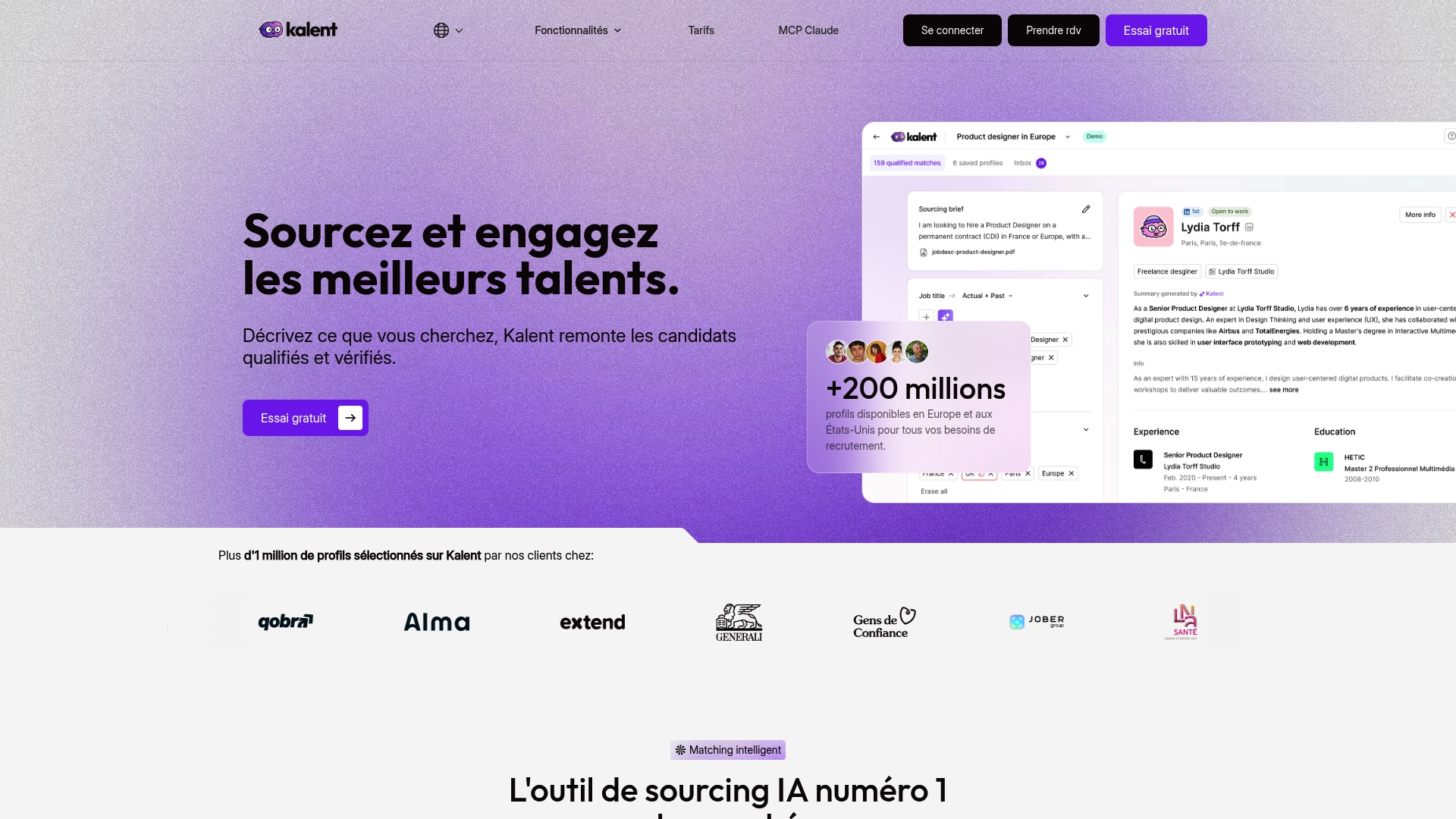
The platform completes each identified profile through its data enrichment, giving access, depending on the case, to mobile numbers and personal email addresses, then automates outreach on LinkedIn, email and WhatsApp. For recruiters handling large volumes of similar roles, this mechanism cuts sourcing time in half compared with building queries manually. The Sourcing plan starts at €79 per month, the Copilot plan at €119 per month, with respective annual prices of €1,490 and €1,790. A demo lets you test the engine on your own open roles.
Sources
- Recruitment and personal data in SMEs: five essential questions to ask | CNIL
- Boolean search in recruitment: the method and the operators | Rocket4RPO
- George Boole | Wikipedia
Frequently asked questions
What are the three main Boolean operators?
The three basic operators are AND (requires all terms to be present), OR (broadens to synonyms or variants) and NOT (excludes a term). Combined with quotation marks and parentheses, they form the structure of most sourcing queries.
How do you run an effective Boolean search?
Start from a broad query grouping job title variants with OR in parentheses, then add skills with AND and exclusions with NOT one at a time. Each change is tested in isolation to identify what actually improves the relevance of results.
What is the definition of a Boolean in search?
A Boolean refers to a value or logic with two states (true/false), stemming from the work of George Boole in the 19th century. In recruitment, this logic is applied through operators (AND, OR, NOT) that combine or exclude terms in a search query.
What are the key sourcing steps before the interview?
Sourcing generally follows these steps: identifying the needs of the role, building the search query, sorting the profiles obtained, then contacting the selected candidates. Kalent automates the last two steps through its talent search engine and multichannel outreach.
Does Boolean search work the same way on every engine?
No, each platform interprets the syntax differently: Google handles nested parentheses well, LinkedIn behaves differently between the standard search and Recruiter, and job boards sometimes limit certain operators. Each query needs to be adapted to the target engine rather than copied as is.


