
Candidate follow-up email: the cadence that actually gets replies
How to follow up with candidates by email effectively: send short messages, bring new value with every touch, and personalize based on a recent signal.
An effective follow-up rests on three principles: it is short, it brings new value with every send, and it offers a minimal call to action. The most powerful lever remains personalization based on a recent signal, which matters more than the number of messages sent. Switching to LinkedIn or moving to WhatsApp only makes sense when a concrete signal justifies it, never by default.
In short:
- Personalization based on a recent signal is more effective than the volume or frequency of messages sent.
- A two-week follow-up schedule with five touches, with the cadence adapted to how critical the role is, optimizes replies.
- Email subject lines should mention something concrete or recent to raise the open rate, avoiding vague or copied phrasing.
- The message body should vary according to the candidate's stage ( sourcing, follow-up, interview, nurturing) and always include a recent, verifiable detail.
- Automation tools enriched with data and able to handle several channels make personalization easier and avoid candidate fatigue.
Table of contents
- When to send your candidate follow-up email, and at what pace
- Which subject lines and hooks actually get your emails opened?
- Which email templates to use depending on the candidate's context?
- How to chain email, LinkedIn and WhatsApp without wearing out the candidate
- Which metrics to track to optimize your follow-ups?
- How Kalent makes these best practices easier to apply
- Why personalization based on a recent signal changes everything
- Following up without hurting your employer brand
- Try Kalent for your next follow-ups
- Sources
- Frequently asked questions
When to send your candidate follow-up email, and at what pace
Timing weighs more than content in the decision to reply. A cadence of five touches spread over about two weeks works for most profiles, provided each message brings something new rather than repeating the same request, as shown by boilr's study on recruiter follow-up strategy.
Here is a baseline schedule to adapt depending on how critical the role is:
- Day 1: first contact or application received, welcome or qualification message.
- Days 3 to 4: first light follow-up, with something new (information about the role, company news).
- Days 7 to 10: follow-up with a more direct CTA. Top Recruteur specifically recommends this window after a first non-reply, a period when personalization and a clear CTA push up the meeting booking rate.
- Day 14: last follow-up, with a clear closing tone.
- Beyond that: move to long-term nurturing, without weekly emails.
A hiring burst, a client deadline or an urgent need justify tightening this schedule to three or four days between touches. Conversely, a passive candidate for a non-priority role can handle a looser pace, one follow-up every two weeks is enough. The stopping rule should be set from the very first message: after the last unanswered follow-up, a graceful exit message closes the door without putting the candidate off, along the lines of “if this isn't of interest to you right now, just tell me and I won't contact you again”.
Which subject lines and hooks actually get your emails opened?
A generic subject line such as “following up on our conversation” gets lost in an inbox. Subject lines that reference a concrete signal, a project, a recent post or hiring news get noticeably more opens, according to the templates compiled by fidforward.
- “[First name], your role at [company] caught my attention”
- “Following your [X] certification, an opportunity that might interest you”
- “[Company] is urgently hiring for [role], a minute to discuss it?”
- “You viewed our [role] job posting, a few useful details”
- “Quick question about your current search”
Always test two variants: a factual version (role, company, skill) against a more personal version (a reference to a project or a public statement by the candidate). The most common mistakes remain the same: a vague subject line that mentions no signal, a hook that copies the previous message word for word, or worse, a tone of artificial urgency that rings false from the very first line.
Which email templates to use depending on the candidate's context?
The body of the message changes radically depending on whether you are sourcing a cold profile, following up on an application with no response, speeding things up after an interview, or reactivating a dormant pipeline. Here are four structures you can adapt directly.
- Initial follow-up (sourcing): “Hi [first name], I noticed you have been [job title] at [company] for [duration]. We are currently supporting [client company] on a [job title] role with [concrete benefit, remote work, compensation, mission]. Would you be up for a ten-minute chat this week?”
- Application with no response: “Hi [first name], your application for the [job title] role has been received. The process is moving a little more slowly than planned on the client side, but your profile is still among the three shortlisted. I will get back to you before [specific date].”
- Post-interview, to speed up a decision: “Hi [first name], thank you for our conversation on [day]. The [job title] role is generating real interest on the client side and a decision is expected before [date]. Do you have any questions that could weigh in your thinking?”
- Nurturing a cold pipeline: “Hi [first name], we haven't had a matching role since our last conversation, but [company] has just opened a [job title] role that fits your profile. Still open to discussing it?”
Pro tip: Always include a recent, verifiable detail (time in current role, company news, specific date for getting back to them) rather than a one-size-fits-all phrase. That detail is what separates a quality follow-up from a mass-sent message.
How to chain email, LinkedIn and WhatsApp without wearing out the candidate
Each channel plays a distinct role in a recruitment follow-up sequence. Email carries the structured content (role details, dates, documents), LinkedIn serves as a light reminder that builds familiarity without weighing on the inbox, and WhatsApp is used as a last resort for urgent or already well-engaged conversations.
- Days 1 to 4: email only, professional and informative tone.
- Day 7: email follow-up + LinkedIn invitation with a short, contextual note, never a full pitch.
- Days 10 to 12: if the candidate has interacted on LinkedIn (viewed, connected, reacted) without replying by email, a brief direct LinkedIn message takes over.
- WhatsApp: reserved for candidates who have already shared their number in the context of an active conversation, never as a first contact.
Adding LinkedIn as a light reminder reduces the pressure felt by the candidate and increases the likelihood of a later reply, with a short, contextual request working noticeably better than a long message, according to boilr. The escalation signal should always come from the candidate, never from the schedule alone: repeated opens without a click, a LinkedIn profile visit, or a partial reply justify switching channels. A complete absence of signal after the fifth touch, on the other hand, justifies stopping.
Which metrics to track to optimize your follow-ups?
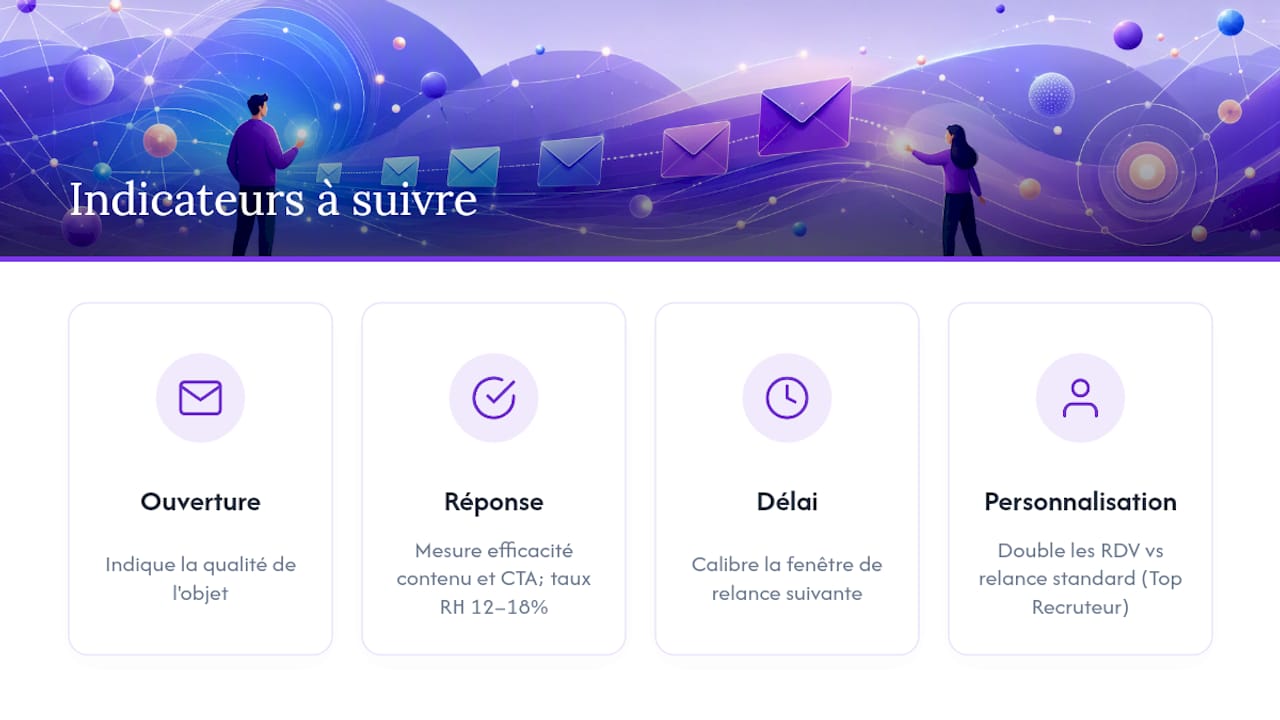
Three metrics are enough to steer a recruitment follow-up sequence: open rate, reply rate and average response time. The open rate signals the quality of the subject line, the reply rate measures the effectiveness of the content and the CTA, and the average response time helps calibrate the next follow-up window.
A simple A/B protocol consists of testing only one variable at a time: the subject line one week, the CTA the following week, never both together or the results get muddled. Reply rates vary widely by sector, with a range of 12 to 18% in HR recruitment according to scal-ia, which identifies relevant timing and personalization based on a recent signal as the two main levers for improvement.
Key figure: in a campaign studied by Top Recruteur, personalization doubled the meeting booking rate compared with a standard follow-up on LinkedIn.
To reduce candidate fatigue, monitor the implicit unsubscribe rate (total silence after three touches) and narrow the list of profiles you follow up with rather than increasing the frequency.
How Kalent makes these best practices easier to apply
A well-built follow-up sequence requires fresh data and a minimum of automation to keep up the cadence without spending your days on it. Technology brings three concrete building blocks to this work:
- Contact data enrichment gives access to verified personal emails and mobile numbers, the raw material for personalization that relies on a real signal rather than an assumption.
- Multichannel automation schedules email, LinkedIn and WhatsApp touches according to the chosen cadence, with dynamic templates that automatically insert personalized variables.
- The Conversational Agent handles first replies and qualification, which frees up time for the follow-ups that genuinely require human judgment.
Why personalization based on a recent signal changes everything
A follow-up email that mentions a signal less than two weeks old (a job change, a LinkedIn post, a certification earned, team performance) doesn't read like the fifty other messages the candidate has received this month.
Three types of signals work particularly well in recruitment. First, career signals: recent tenure in a role, a change of job title, a promotion visible on the professional profile. Next, company signals: a funding round, a layoff plan, a restructuring, which make a candidate more or less available at a given moment. Finally, content signals: a shared article, a public statement, a reaction to a post on an industry topic.

Social proof usefully complements these signals without replacing them. Mentioning that a former colleague of the candidate has joined the same client, or that a similar profile was recently placed in a comparable role, reassures without tipping into a forced appeal to authority. For high-volume pipelines, automating the collection of these signals and inserting them into message templates keeps this level of relevance without multiplying manual tasks with every send.
Following up without hurting your employer brand
The real test of a good follow-up sequence isn't the reply rate, it's what the candidate thinks of you after ignoring everything. Too many recruiters confuse persistence with relevance, stacking up touches without ever varying the substance of the message. The rule that really matters: every follow-up must bring something new, otherwise it doesn't deserve to be sent. A polite exit framework, offered from the very first message, protects your reputation as much as it respects the candidate's time.
Jules
Try Kalent for your next follow-ups
Building a follow-up sequence that holds up requires up-to-date data, several synchronized channels and time that few HR teams have to spare. One solution brings these three elements together in a single tool: search across a large volume of profiles in Europe and the United States, access to enriched contact details, and automated outreach via email, LinkedIn and WhatsApp from one interface.
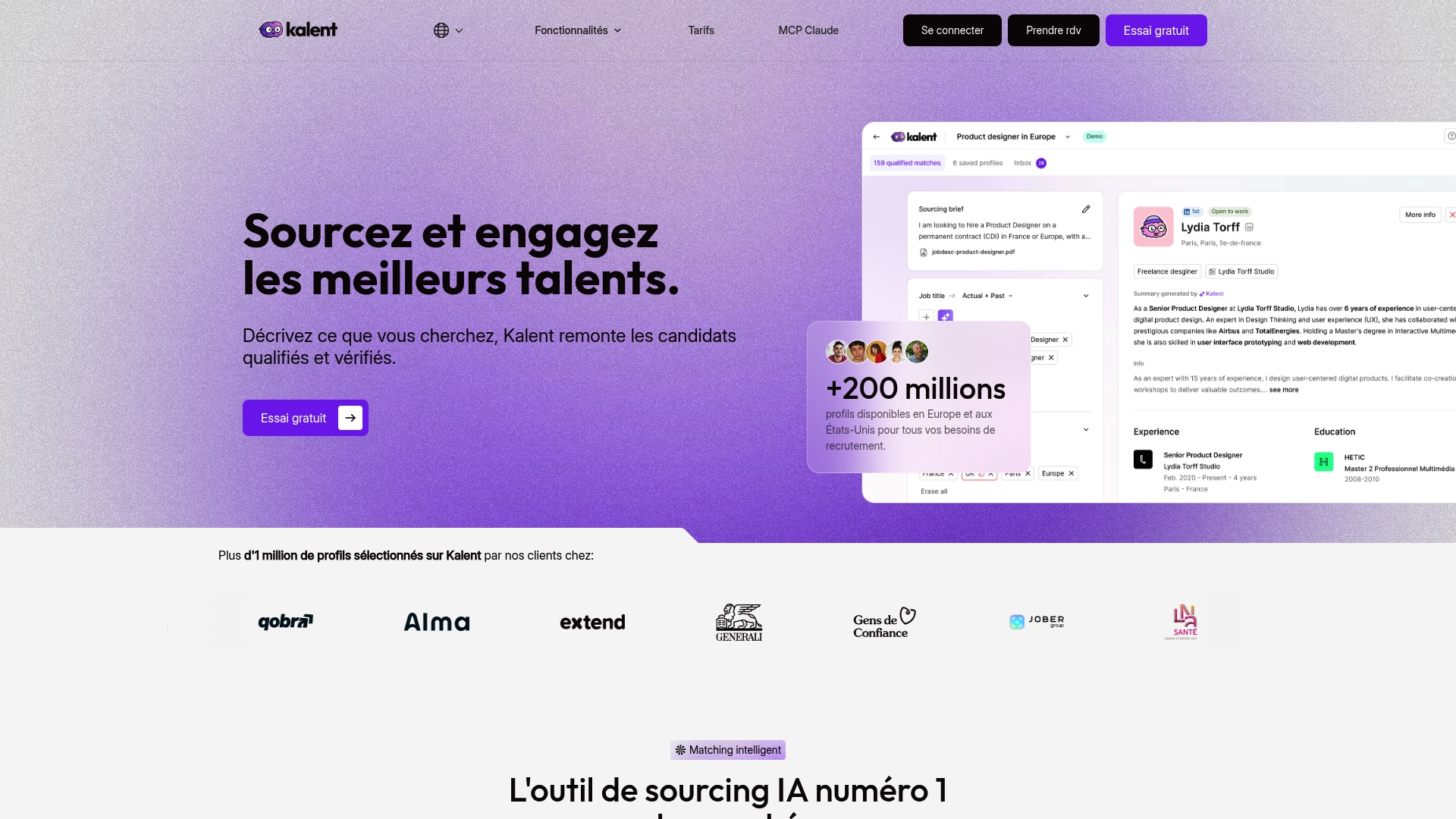
The talent search engine spots the recent signals that justify a targeted follow-up, while the Conversational Agent handles the first exchanges so your teams can focus on the conversations that really matter. Human personalization remains irreplaceable for high-stakes messages, automation takes care of the rest. See Kalent's pricing page or book a demo to see how a multichannel sequence is built in practice on your own pipelines.
Sources
Find the benchmarks cited from boilr, scal-ia, Top Recruteur and fidforward, as well as Kalent's analysis of open rates by channel.
- Recruiter Follow-Up Strategy (2026): How to Follow Up Without Annoying Prospects (Email + LinkedIn) | boilr Blog
- Cold email reply rates: benchmarks and levers (2026) | scal-ia
- Application reply rates: 2025 Benchmark | Top Recruteur
- 7 Follow Up Email Recruiter Templates That Actually Get Replies in 2026 | fidforward
Frequently asked questions
How many follow-ups should you send before stopping?
Three to five touches over about ten days are generally enough, with each message bringing something new rather than simply repeating the request.
When is the best time to follow up with a candidate who hasn't replied?
A first follow-up at 3 or 4 days, then a second between the end of the first week and the tenth day, is often recommended as an effective window after a first non-reply.
Should you follow up differently with a passive candidate and an active candidate?
Yes: an active candidate can handle a tighter cadence with a direct CTA, while a passive candidate responds better to a spaced-out pace and content that gives value rather than asks for something.
How do you personalize a follow-up without spending hours on it?
By relying on enriched contact data and dynamic templates that automatically insert recent signals, an approach that tools like Kalent make it possible to scale without sacrificing relevance.
Does a candidate follow-up email pose a GDPR risk?
Processing contact data must rest on a clear legal basis and allow easy unsubscribing, which means documenting where the contact details used came from and respecting the candidate's right to object at any time.


