
Candidate persona: how to create it and use it in recruitment
Build a candidate persona from your data to target your messages, speed up screening and reduce the number of unqualified applications.

A candidate persona is a semi-fictional representation of the talent profile you want to attract, built from real data (ATS, interviews, analytics from your careers pages) rather than from intuition. Its immediate benefit: targeting your messages and your sourcing channels at the right people, which reduces the time spent screening poorly qualified applications.
In short:
- Creating a candidate persona lets you target profiles precisely, which improves the quality of applications and reduces useless volume.
- An effective persona must stay simple, focused on professional and behavioural criteria, while avoiding discriminatory demographic criteria.
- Validating the persona relies on A/B tests, tracking the response rate and the impact on time-to-hire, with a review twice a year recommended.
- Putting the persona to work in sourcing means targeting channels, personalising messages and automating across several channels.
- Automated enrichment of contact details and regular updates of personas are essential to turn a theoretical profile into a real contact.
Table of contents
- What is a candidate persona?
- Why create candidate personas: the measurable benefits
- The essential elements of a candidate persona
- Practical steps to create and validate a persona
- Pitfalls to avoid and compliance
- Quick examples and a reusable template
- Measuring the impact of a candidate persona on recruitment
- How to integrate the persona into your sourcing strategy
- What field experience reveals about candidate personas
- Activating your candidate personas with Kalent
- Sources
- Frequently asked questions
What is a candidate persona?
A candidate persona is not a job description dressed up differently. The job description lists requirements; the persona describes a person with their motivations, their job search habits and their potential hesitations about your offer. It is the direct adaptation of the marketing persona (the famous "buyer persona") applied to recruitment, and it relies on qualitative and quantitative data rather than on recruiter assumptions.
This distinction changes the way you work. A job description answers the question "what must this candidate be able to do?". A persona answers "who is this person, where are they, and what will convince them to apply?".
The persona fits into an inbound recruiting approach: instead of waiting for applications, you actively go after the profiles that match, with a message calibrated for them. In practice, a candidate persona brings together:
- A professional profile (skills, experience, industry of origin)
- Motivations and triggers for changing jobs
- Preferred channels and content formats
- Likely objections to your offer or your company
Why create candidate personas: the measurable benefits
Sourcing without a persona looks like a random search. With a well built persona, you turn that search into precise targeting, a bit like a metal detector that isolates the useful signal from the surrounding noise.
Three concrete effects usually stand out. First, the quality of applications rises while their raw volume may drop, which remains a good trade-off when your teams spend too much time filtering off-target profiles. Next, time-to-hire shrinks because your messages speak directly to the real motivations of the targeted candidate, instead of spreading a generic job ad across every possible channel.
The persona also improves the candidate experience. A message that answers the precise expectations of a profile (pay, flexibility, type of assignments) generates more positive replies and strengthens the employer brand, including among candidates who decline the offer.
The most reliable validation remains empirical: crossing feedback from the ATS, manager interviews and the analytics of your careers pages lets you check that a persona really improves your recruitment indicators, rather than remaining an attractive hypothesis on paper.
The essential elements of a candidate persona
A useful persona fits on one page. Beyond that, it becomes a document nobody reads. Here are the sections that really make a difference in daily use:
- Priority technical skills: the three to five non-negotiable skills, not an exhaustive list of keywords.
- Observable soft skills: autonomy, ability to work in a distributed team, comfort with ambiguity. Phrase them as concrete behaviours rather than vague adjectives.
- Career stage: is this candidate looking for progression, a career change, a return after a break? This information shapes the tone of your message.
- Motivations and triggers: pay, meaningful work, work-life balance, stability. A persona without motivations is just a typical CV, not a persona.
- Behaviours and preferred channels: LinkedIn, technical forums, referrals, alumni networks. Specify where this profile really spends time.
- Likely objections: what could make this candidate hesitate about your company or your industry, so you can prepare an answer in your outreach message.
The choice of fields matters as much as their content. Always favour professional and behavioural criteria (skills, seniority, declared geographic mobility) over demographic criteria, which expose the company to a risk of discrimination and bring no predictive value on job performance, as HR practitioners point out on this subject.
Pro tip: Test each field of your persona with this simple question: "Does this criterion help me write a better outreach message, or is it just there to reassure me?" If the answer is the second, delete the field.
Practical steps to create and validate a persona
Creating a candidate persona in a collaborative workshop avoids the bias of a single recruiter projecting their own preferences. Here is a repeatable method in four stages.
- Prepare the data upfront. Gather the CVs of your latest successful hires, your ATS statistics and two or three managers available for the workshop.
- Run a 90 minute workshop. Ask concrete questions: "What convinced our latest senior hire to accept the offer?", "Where were they actively looking for a job?". Summarise the answers in a one page document.
- Test the persona in the field. Launch two variants of the outreach message on the identified channel and compare the qualified response rates.
- Set up a review cycle. A review roughly every six months lets you adjust the persona to market changes without rebuilding it entirely each time.
| Step | Key action | Sign of success |
|---|---|---|
| Preparation | Collect ATS data, CVs, manager availability | Data gathered before the workshop |
| Workshop | Question managers about the best hires | One page persona document produced |
| Test | A/B test messages and channels | Qualified response rate measured |
| Review | Schedule a review every six months | Persona dated and updated |
This workflow is deliberately light. A persona that requires three weeks of work before its first use loses its practical value.
Pitfalls to avoid and compliance
The main danger of a candidate persona is overfitting: turning it into a list of criteria so precise that no real candidate ever matches it. A persona should remain a compass, not an exclusion list that unfairly filters out valid profiles.
The second danger directly concerns compliance. Never introduce demographic criteria (age, origin, family situation, gender) into a persona, even implicitly through phrases like "dynamic young graduate". These criteria expose you to a risk of hiring discrimination and bring no useful information about the real ability to do the job.
A few simple rules limit this risk:
- Phrase each field in terms of skills or observable behaviours, never personal characteristics.
- Have your legal department validate any persona touching sensitive populations (young graduates, seniors, people changing careers).
- Prefer several personas per job family (junior, senior, career change) over a single persona that is too rigid, which widens the pool without losing precision.
Quick examples and a reusable template
Two mini examples show how to adapt the same sections to very different profiles.
| Section | Senior front-end developer | Digital marketing work-study student |
|---|---|---|
| Key skills | React, TypeScript, front-end architecture | Social media, basic analytics, curiosity about data |
| Career stage | Looking for greater technical responsibilities | First significant professional experience |
| Main motivation | Technical autonomy, modern stack | Hands-on mentoring, skills development |
| Preferred channel | GitHub, technical forums, referrals | LinkedIn, school forums, Instagram |
| Likely objection | Lack of career progression prospects | Workload incompatible with classes |
This table is easy to reproduce: keep the same rows (skills, career stage, motivation, channel, objection) and adjust the content according to the targeted role. It is the minimal skeleton of a usable one page persona.
Measuring the impact of a candidate persona on recruitment
A persona that changes nothing in your indicators is just a theoretical exercise. Measure its impact on three distinct levels.

At the sourcing level, compare the qualified response rate before and after introducing the persona on a given channel. A clear increase signals that your message is finally speaking to the right person, not just to a larger number of people.
At the process level, track time-to-hire and the conversion rate between application and interview. An effective persona generally reduces the number of interviews needed to identify a candidate who fits the role, because the initial filtering is already more relevant.
At the quality of hire level, the real test comes after recruitment: do the people hired through a refined persona stay longer, and do they reach their objectives faster than hires from untargeted sourcing? This data takes some hindsight, generally six months to a year, but it remains the strongest proof that a persona works.
A simple tracking table, with these three levels of indicators, is enough to know whether a persona deserves to be kept, adjusted or abandoned. The absence of measurement is in fact the most frequent pitfall: many HR teams build a carefully crafted persona, then never check whether it changed anything in their concrete recruitment results.
How to integrate the persona into your sourcing strategy
A persona that stays in a shared document without operational use is useless. Its real integration relies on three levers.
First, channel targeting: once the persona is defined, direct your sourcing budget and time toward the channels this profile really uses, rather than posting uniformly on every available platform. A senior developer persona justifies a presence on specialised technical forums rather than a simple generic LinkedIn post.
Next, personalising outreach messages: each persona should generate a different message, one that answers its motivations directly and anticipates its objections. A single message sent to very different profiles mechanically dilutes its effectiveness, even if it is well written.
Finally, multichannel automation: once the persona is validated, structuring a consistent approach across several channels (LinkedIn, email, sometimes WhatsApp) lets you reach the same profile where they are most receptive, without multiplying the manual work of personalisation. This consistency between persona and activation channels often remains the weak link in sourcing strategies, far more than the quality of the persona itself.
What field experience reveals about candidate personas
Most HR teams build a decent persona from the very first workshop. What is almost always missing is the discipline of reviewing it: a persona dated early 2025 and never touched since silently becomes obsolete, without any recruiter really noticing, because nothing visually signals that an HR document has expired.

My opinion, after observing many use cases: the value of a persona does not come from its sophistication but from being regularly confronted with real ATS data. A persona that is never compared with the profiles actually hired remains a useful fiction for a meeting, not a sourcing tool.
On the technical side, automatic enrichment of contact data concretely changes the game for activating a persona: a targeted profile without usable contact details remains theoretical, whereas reliable access to a mobile number or a personal email immediately turns a persona into a real contact campaign. Integrating this persona into technical workflows, connected to your ATS and driven by automated multichannel campaigns, is what separates a definition exercise from a tool that sourcing teams really use every day.
Jules
Activating your candidate personas with Kalent
A well defined persona is only worth its ability to find real people and contact them effectively. Kalent gives access to more than 200 million qualified profiles in Europe and the United States, with a search engine that filters directly on the criteria of your persona: skills, career stage, industry of origin.
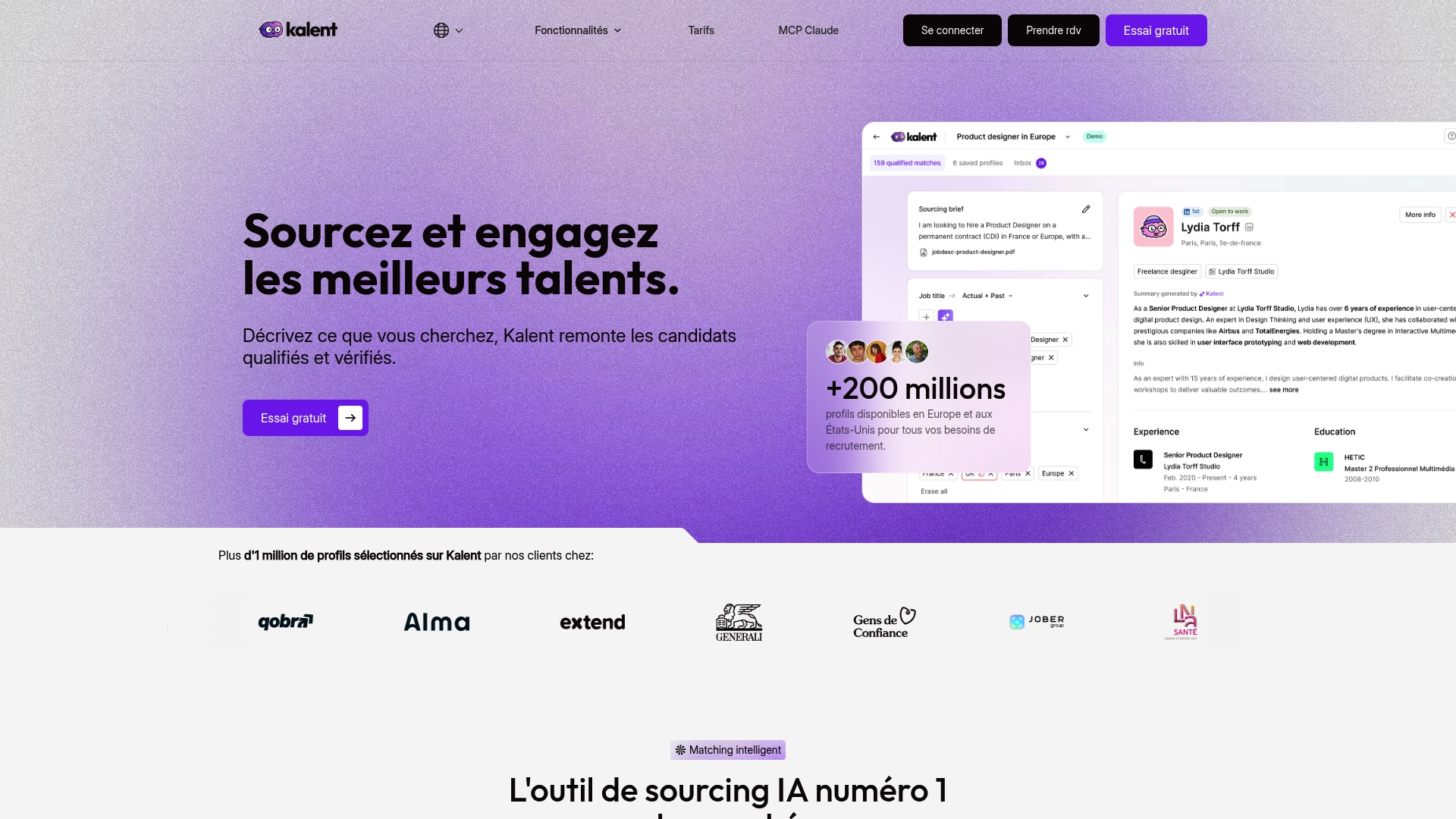
The platform completes this targeting with contact detail enrichment, with access to 80% of mobile numbers and 60% of personal emails, which makes each persona immediately actionable rather than theoretical. Contact is then automated on LinkedIn, email and WhatsApp through Kalent's conversational agent, with messages adapted to each candidate segment identified. Integration with your ATS, notably through the Beetween connection, lets the persona flow directly into your existing tools without double entry. Try the talent search engine on your next persona and book a demo to assess the time saved on your current sourcing process.
Sources
A persona built on a recruiter's intuition remains a hypothesis. A persona built on several cross-checked sources becomes a reliable working tool.
Four sources naturally complement each other:
- Candidate persona | DataLegal
- The notion of candidate persona, a formidable weapon in recruitment! | ADP France
- Jobology, Candidate persona (blog)
Combining internal surveys and analytics also helps pinpoint where your ideal candidates are: which professional groups, which schools, which technical watch channels they really follow.
An often neglected point: date and version each persona. A persona written in the first quarter of 2024 on a tight tech market no longer has the same relevance two years later. Treat it as a tool tied to a time and a place, reviewed at regular intervals rather than set in stone.
Frequently asked questions
What exactly is a candidate persona?
A candidate persona is a semi-fictional representation of a target talent profile, built from real data (ATS, interviews, analytics) rather than intuition, to guide sourcing targeting and messages.
What are the main types of persona in recruitment?
Recruiters generally distinguish personas by job family (junior, senior, career change), which widens the candidate pool without diluting the precision of each targeted profile.
What is the difference between a candidate persona and a job description?
The job description lists the technical requirements of the role, while the persona describes a real person: their motivations, their job search channels and their likely objections to an offer.
How do you validate that a candidate persona really works?
By crossing feedback from the ATS, manager interviews and A/B tests of messages on different channels, then measuring the change in the qualified response rate and in time-to-hire.
How often should you review a candidate persona?
A review roughly every six months is a common good practice, because a persona treated as a tool tied to a time and a place goes out of date as the job market evolves.


