
Developer recruitment sourcing: the method that speeds up your results
Speed up developer hiring by combining job boards, networks and proactive outreach, with an automated sequence.

To source developers fast, prioritize three complementary channels: specialized job boards, professional networks and targeted proactive outreach, then apply a short sequence: a precise brief, a targeted search, a brief message, a multichannel follow-up. A platform like Kalent can speed up each of these steps through automation and contact data enrichment.
In short:
- Effective sourcing requires combining channels such as job boards, professional networks, schools and events, adjusting according to scarcity, timeline and budget.
- Building a structured sourcing sequence, from defining the need to qualification, optimizes the timeline and the relevance of applications.
- Automation and enriched data tools, like Kalent, make it possible to cut the time spent on searching and first contacts in half.
- Managing freelancers on a project basis requires regular follow-up and clear communication about the assignment, availability and contractual terms.
- Sourcing performance relies on measuring the response rate, qualification, time to first contact and the interview conversion rate.
Table of contents
- Which sourcing channels to choose depending on the profile you need
- The step-by-step workflow for sourcing a developer
- Tools, automation and metrics to steer sourcing
- What a sourcing specialist must deliver today
- How an AI sourcing platform concretely changes day-to-day work
- Managing the relationship with freelancers and project-based developers
- How much sourcing costs and how to optimize that budget
- What will really matter in sourcing in 2026
- How Kalent fits into your sourcing process
- Sources
- Frequently asked questions
Which sourcing channels to choose depending on the profile you need
The choice of channel depends on three variables: how rare the profile is, the deadline imposed and the available budget. A senior developer specialized in cloud is not found the same way as a junior profile still in training.
General job boards and sponsored job ads work well for common profiles, where the volume of applications makes up for the lack of fine targeting. They remain ineffective for rare skills, where proactive outreach takes over.
Professional networks let you approach profiles that are not actively applying directly. It is often the most cost-effective channel for experienced developers already in a job, provided each message is personalized.
Partnerships with engineering schools and tech communities open regular access to junior profiles, with a low acquisition cost but a longer setup time. Events, meetups and hackathons play a different role: they serve passive detection and building a talent pool, more than immediate hiring.
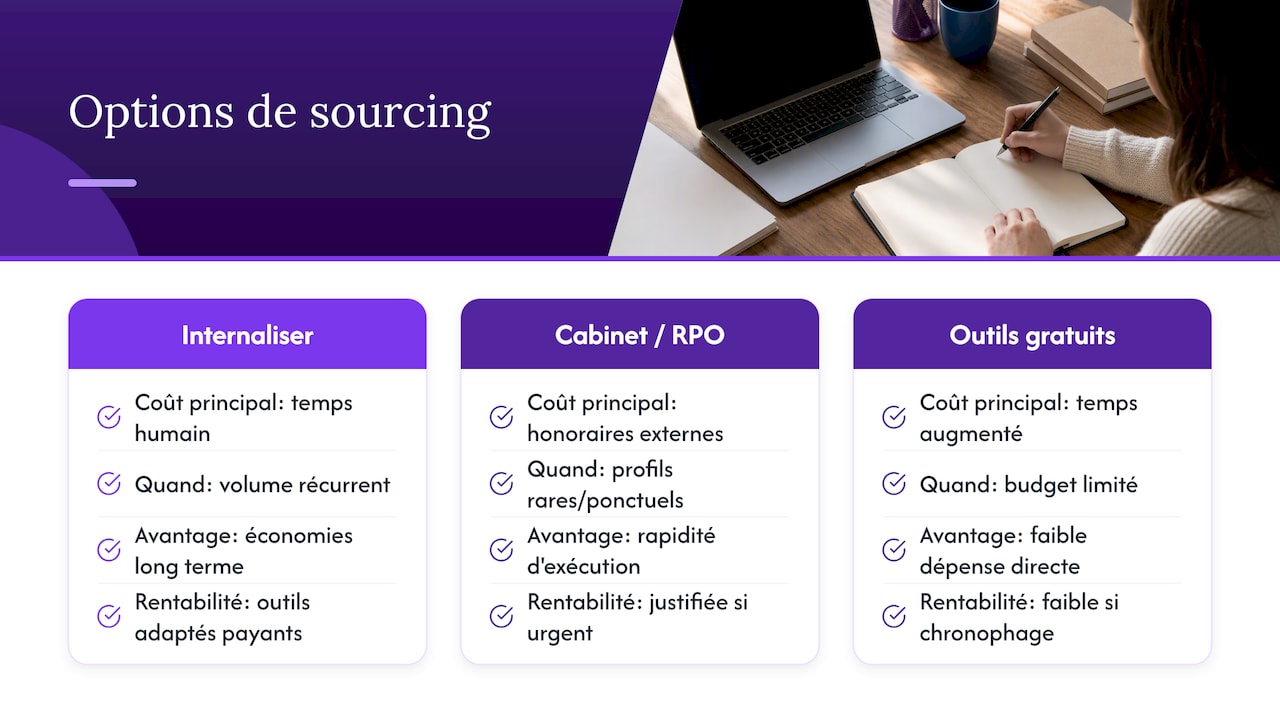
Finally, a specialized agency or an RPO (Recruitment Process Outsourcing) solution remains relevant when the deadline is very tight and internal resources are lacking, at a higher cost per hire.
- Job boards: high volume, weak targeting, moderate cost.
- Professional networks: precise targeting, high personalization effort.
- Schools and communities: junior profiles, long setup time.
- Events and hackathons: passive detection, talent pool building.
- Specialized agencies and RPO: speed, higher cost per hire.
Some analyses of networking channels, such as the one by Digitalease et vous, point out that no single professional network covers every need: combining several sources remains the most reliable practice.
The step-by-step workflow for sourcing a developer
An effective sourcing sequence follows a precise order, from the initial brief to the final qualification of the candidate.
- Frame the need with the manager: exact tech stack, responsibilities of the role, must-have criteria and bonus criteria. A vague brief multiplies back-and-forth exchanges and lengthens the sourcing timeline.
- Build broad, then refined search queries: start from a combination of technical keywords and job-title synonyms, then narrow down gradually by experience and location.
- Write a three-line outreach message: the first line hooks with a personalized element from the profile, the second presents the role in one sentence, the third invites a quick, no-commitment conversation.
- Plan a multichannel follow-up cadence: a first message on the professional network, an email follow-up three days later, then a last contact by SMS or WhatsApp if the candidate has authorized that channel.
- Qualify each reply with a simple status: interested, to recontact later, not relevant. Each status triggers a specific action, so that qualified candidates do not get lost in the follow-up.
Pro tip: systematically vary the first line of the outreach message according to the profile's trigger (recent project, published article, job change): the response rate depends directly on it.
Tools, automation and metrics to steer sourcing
Modern sourcing relies on four categories of tools: talent search engines, contact data enrichment solutions, ATS to centralize applications, and outreach automation tools to manage follow-up sequences.
Performance management relies on simple metrics to track week after week:
- Response rate: share of messages that received a reply, across all channels.
- Qualification rate: share of respondents who actually match the criteria of the role.
- Time to first contact: time elapsed between identifying the profile and sending the first message.
- Interview conversion rate: share of qualified candidates who accept a first conversation.
Measuring the cumulative response rate per multichannel sequence, for example by combining a first LinkedIn contact, an email follow-up on day 3 and an SMS reminder on day 7, makes it possible to identify the best-performing channel for a given candidate pool, according to Apec market data.
Building GDPR compliance into these workflows is not a side option: it must be designed in from the start of enrichment and outreach sequences, in particular through the traceability of the data sources used.
What a sourcing specialist must deliver today
The sourcing specialist holds a pivotal position between searching for profiles and converting them into qualified candidates. Their concrete tasks cover active search, qualification by phone or in writing, nurturing candidates not selected for now, and regular reporting to HR teams.
The expected skills fall into two groups:
- Hard skills: command of sourcing tools and search operators, enough understanding of tech stacks to assess a profile's relevance without engineering expertise.
- Soft skills: interpersonal skills to start a conversation with developers who are constantly solicited, persuasiveness without commercial aggressiveness, rigorous organization to follow several pipelines in parallel.
Performance is measured less by the number of messages sent than by the quality of the pipeline generated: an effective sourcing specialist prioritizes profiles with high conversion potential over the raw volume of contacts made.
How an AI sourcing platform concretely changes day-to-day work
A platform like Kalent illustrates what AI can bring to this workflow. Kalent claims access to more than 200 million profiles in Europe and the United States through its talent search engine, with an announced access rate of 80% to mobile numbers and 60% to personal emails.
- Profile search without complex Boolean queries, through an intelligent matching engine.
- Automatic contact data enrichment to speed up direct outreach.
- Multichannel outreach automation on LinkedIn, email and WhatsApp, with a claimed 50% reduction in sourcing time.
A typical scenario: a sourcing specialist sets up a targeted search in the morning, lets the tool enrich and send the first messages, then spends the afternoon on qualified replies.
Managing the relationship with freelancers and project-based developers
Sourcing does not stop at permanent hiring. A growing share of development needs is covered through freelancers or project-based developers, which changes the nature of the relationship to maintain.
Unlike a typical job seeker, a freelancer assesses an assignment on its duration, their daily rate and its compatibility with their current commitments. Communication must therefore be more direct on these three points from the first contact, or you risk wasting time on conversations that will go nowhere.
Maintaining a pool of qualified freelancers requires different follow-up from a classic pipeline: regular contact, even when there is no immediate assignment, keeps the relationship alive and shortens the mobilization time when an urgent need arises. Many sourcing specialists underestimate this groundwork, only reaching out to freelancers when the need arises, which sharply reduces the chances of quick availability.

Qualifying a freelancer also involves specific criteria: references from previous assignments, ability to integrate quickly into an existing team, and clarity on contractual terms. These elements deserve to be documented just like technical skills, to avoid unpleasant surprises during the assignment.
How much sourcing costs and how to optimize that budget
The cost of sourcing breaks down into three main items: the human time spent on searching and qualification, subscriptions to tools and databases, and, where applicable, the fees paid to an agency or an RPO solution.
Human time often remains the heaviest item, because it includes building queries, writing messages and following up. Automating part of these repetitive tasks, in particular contact enrichment and sending the first messages, frees up that time for higher-value tasks, fine qualification and interviews.
Using a specialized agency or an RPO is mainly justified for one-off needs or very rare profiles, where the cost per hire is offset by speed of execution. For recurring hiring volume, bringing sourcing in-house with the right tools generally becomes more economical over time.
Optimizing the budget comes down to a simple principle: measure the cost per qualified candidate, not just the cost per tool. A more expensive subscription that significantly reduces search time and improves the response rate can turn out to be more profitable than a free but time-consuming solution.
What will really matter in sourcing in 2026
The market shows an overall drop in job posting volumes for developers in 2025, while marked shortages persist in specialties such as data and cloud. Employer branding and flexibility now weigh more than the volume of applications: it is better to focus your efforts on precise niches and on internal upskilling than to multiply generic job ads.
Jules
How Kalent fits into your sourcing process
Kalent turns the workflow described above into a largely automated sequence, without removing human judgment from the final qualification. The platform relies on its database of more than 200 million enriched profiles to shorten the search phase, then automatically sends the first messages on LinkedIn, email and WhatsApp.
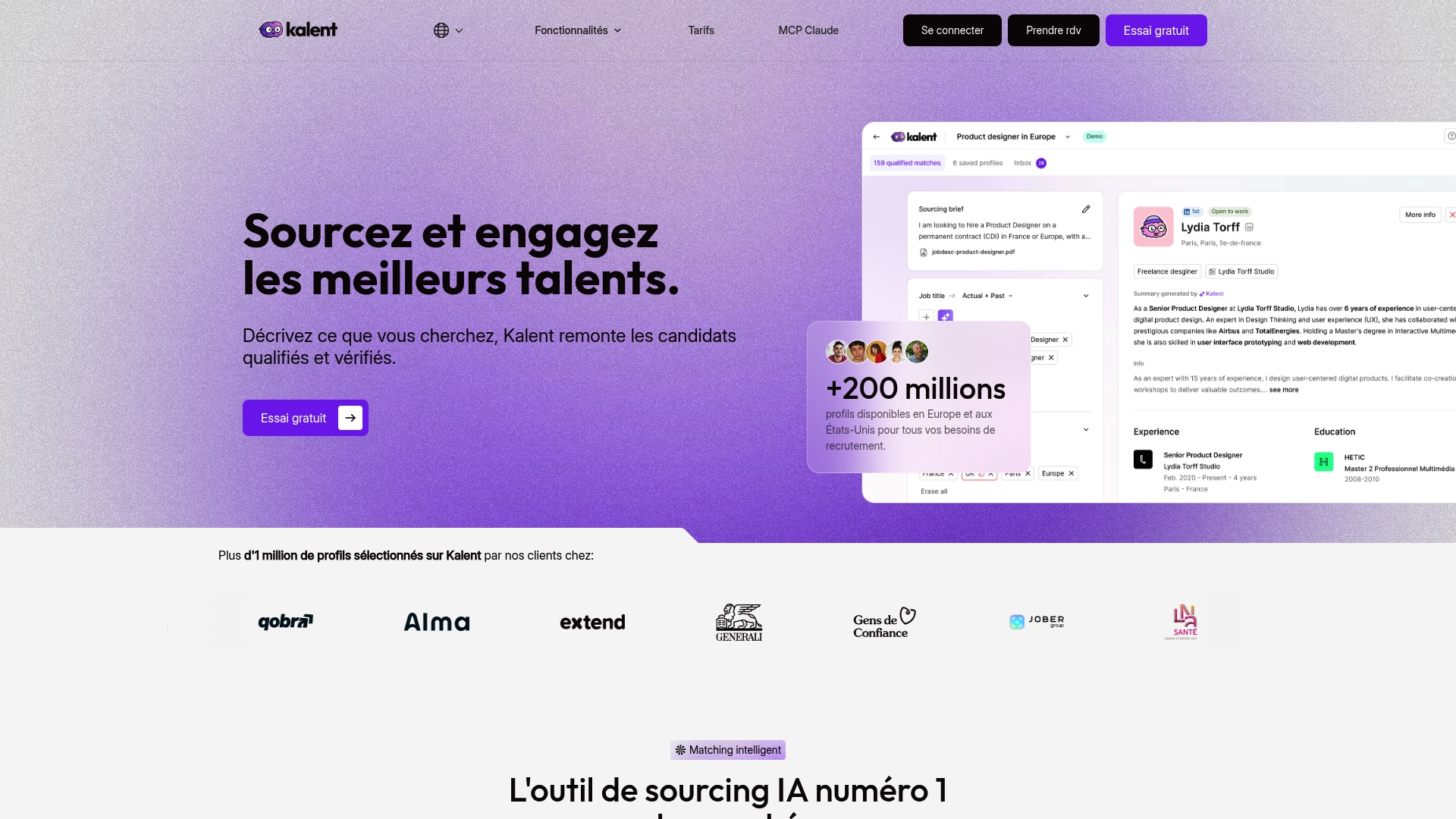
- Profile search through an intelligent matching engine, without complex Boolean queries.
- Automatic enrichment of direct contact details to go beyond the professional network's messaging alone.
- Multichannel follow-up sequences configured once, then executed automatically.
The Sourcing (€79 per month or €1,490 per year) and Copilot (€119 per month or €1,790 per year) plans cover different levels of automation; the Team plan is available on request. Check the Kalent pricing and book a demo to assess the impact on your own hiring volume.
Sources
To dig deeper into the regulatory aspects of sourcing, see the CNIL guide on recruitment and the market data published by Apec.
- Demand for developers and IT project managers erodes in 2025, Le Monde Informatique
- Apec, Observatory of executive professions
Frequently asked questions
What is the average salary of a sourcing specialist?
Salary scales depend largely on the size of the company and the scope of the tasks assigned.
What is sourcing in recruitment?
Sourcing refers to all the techniques used to identify, approach and qualify potential candidates before they even actively apply to a job posting. It relies on proactive search across several channels, from the professional network to enriched databases.
Which software should you choose for sourcing developers?
The choice depends on hiring volume and the level of automation you are looking for: some tools focus on profile search, others on contact enrichment or follow-up automation. Kalent combines these three functions through its talent search engine, with claimed access to more than 200 million profiles in Europe and the United States.
Which companies hire the most web developers?
Demand for web developers is still driven by technology companies, software publishers and organizations bringing their digital transformation in-house, even though the overall volume of job postings fell in 2025 according to industry analyses. Profiles specialized in data and cloud remain particularly sought after despite this general decline.


