
LinkedIn recruiting campaigns: the sequence that actually gets candidates to reply
Optimize your LinkedIn recruiting campaigns: a short, personal message, two follow-ups max, then a quick switch to email or WhatsApp.

The formula that works fits in one sentence: a short, personalized opening message, two follow-ups at most spaced a few days apart, and a quick switch to email or WhatsApp as soon as a candidate shows a sign of interest. Everything else, targeting, timing, ATS integration, serves this simple mechanism.
In short:
- Precise targeting based on activity signals and the candidate’s recent intent significantly increases the reply rate.
- Limiting yourself to two follow-ups at D+3 and D+7 avoids candidate fatigue while maximizing the campaign’s effectiveness.
- The switch to a direct channel such as email or WhatsApp should happen as soon as clear interest is shown, after first verifying the contact details.
- Automate only repetitive tasks such as capture, enrichment and follow-ups, while keeping the initial messages personalized.
- Using a workflow connected to the ATS avoids duplicates and tracks every interaction for consistent management.
Table of contents
- Quick checklist before launching a LinkedIn recruiting campaign
- How do you build an effective LinkedIn recruiting sequence?
- How do you orchestrate LinkedIn, email and ATS without creating duplicates?
- Which metrics should you track to optimize a LinkedIn recruiting campaign?
- How do you avoid LinkedIn penalties and protect your employer brand?
- What field experience changes about the theory of LinkedIn sequences
- How Kalent simplifies running these campaigns
- Sources
- Frequently asked questions
Quick checklist before launching a LinkedIn recruiting campaign
Before activating a sequence, check that these five elements are in place. A campaign that is poorly prepared upfront produces disappointing reply rates, however good the message is.
- Precisely defined ICP: job titles, seniority, industry, and activity signals (recent job change, a post, interaction with HR content).
- Sequence written in advance: one opening message and two follow-ups at most, with variants depending on the targeted persona.
- Spacing rules set: first contact on D, first follow-up on D+3, second on D+7.
- Tracking connected to the ATS: every interaction (view, acceptance, reply) must flow into the candidate’s history.
- Active deduplication rules: the same profile must never receive two different sequences in parallel, sent by two recruiters from the same team.
Pro tip: before launching any sequence, run your prospect list through a duplicate filter cross-checked against your ATS. That, and not the message, is often where the first impression left on a candidate is decided.
How do you build an effective LinkedIn recruiting sequence?
An outreach campaign that converts rests on three pillars: targeting that identifies the right moment, a message that does not look like an automated message, and a follow-up timing that respects the candidate’s attention without letting them slip away.
-
Combine Boolean search and activity signals. A search by job title and industry remains the foundation, but it is no longer enough. A candidate who has just posted about a job change, or who has interacted with content related to their field in the last two weeks, responds much better to outreach. Signal-based targeting and timing tied to a trigger event clearly increase reply rates, with some analyses citing a 32 % lift compared with a non-contextualized approach.
-
Write a short, conversational opening message that asks a low-friction question. Forget phrases like “I am looking for a profile matching your experience”. Mention a specific element of the profile or career path, then ask a simple question that calls for a one-sentence answer: “Are you open to discussing a role at [company]?” works better than a wall of text describing the job.
-
Schedule the first follow-up at D+3, with a different angle. Never repeat the initial message. Bring something new: a detail about the role, company news, or a follow-up question.
-
Schedule the second and final follow-up at D+7. Beyond that, effectiveness drops sharply and the risk of wearing out the candidate outweighs the potential benefit of a third contact.
-
Personalize at scale with three to four merge fields. First name, current company, current role, and one element specific to the profile or project are enough to give the impression of a message written for that particular candidate, even in a sequence automated across several hundred profiles.
-
Stop the automation as soon as a sign of interest appears. A positive reply, a question about the role, or even a simple “why not, tell me more” should trigger an immediate manual action. This is the moment when automation must hand over to a recruiter, not keep running on its own momentum.
Pro tip: keep the first message and the two follow-ups in a human-written form, even if sending is automated. Instead, hand the administrative tasks, profile capture, enrichment, reminders, over to automation. It is this split that lets you sustain a high volume without sacrificing the quality the candidate perceives.
How do you orchestrate LinkedIn, email and ATS without creating duplicates?
The operating rule is simple: as soon as a candidate shows interest on LinkedIn, you move the conversation to a more direct channel, email or WhatsApp, where the read rate is higher and follow-up is more reliable.
This switch requires enriching the contact details first, with compliance checks before any direct contact by email or phone. It also requires an ATS that centralizes all interactions, so that no recruiter follows up with a candidate who is already in conversation with a colleague.
- Capture: the identified profile enters the pipeline from the first LinkedIn contact.
- Enrichment: retrieval of the mobile number and personal email, with a compliance check.
- Multichannel sequence: the conversation continues on the channel where the candidate responds best.
- Qualification: move to a phone or video interview as soon as interest is confirmed.
- ATS record: a complete history that the whole recruiting team can consult.
Workflows connected to the ATS remain the best practice to avoid losing context and to prevent recruiters from following up on the same candidates, a problem more common than you might think as soon as a team has more than two or three people active on the same talent pools.
Which metrics should you track to optimize a LinkedIn recruiting campaign?
Four metrics are enough to steer a campaign: the invitation acceptance rate, the message reply rate, the conversion rate to interview, and the average time between first contact and reply.
For recruiting, performance benchmarks exceed the platform’s overall average: well-executed signal-based targeting can push the reply rate well above the standards seen on conventional sales campaigns.
- Acceptance rate: measures the relevance of the targeting and the quality of the connection message.
- Reply rate: the most telling indicator of the quality of the personalization.
- Conversion to interview: the real business goal, never to be lost sight of behind engagement metrics.
- Average reply time: a longer delay often signals fatigue in the targeted talent pool.
Prioritize improving the targeting before the messages: good targeting sometimes doubles the reply rate, while a better-written message sent to a poorly defined audience brings a marginal gain. Test only one parameter at a time, opening message, follow-up timing, or ICP definition, and analyze the results every week at launch, then monthly once the campaign has stabilized.
How do you avoid LinkedIn penalties and protect your employer brand?
An account that sends too many invitations and messages in a short time draws the attention of LinkedIn’s detection systems, with a real risk of temporary restriction.
- Limit your daily volume of actions and space out your sends to mimic natural usage behavior rather than a mechanical rhythm.
- Never hand the entire first contact over to automation: keep a share of genuine personalization, otherwise the candidate feels it immediately.
- If you get blocked or reported, reduce the volume immediately and space out your next sends further before resuming.
- Get implicit or explicit consent before switching to email or SMS, in line with the data protection rules that apply in France.
Excessive automation of sourcing remains a real risk of dehumanizing recruitment, with some studies suggesting that a large share of candidates prefer human contact at a key moment in the process.
What field experience changes about the theory of LinkedIn sequences
The figures on sourcing automation are solid: time saved, a higher volume of qualified contacts, less repetitive work. That is precisely what automation techniques applied to LinkedIn sourcing report. But the most telling data point is not the one cited most often.
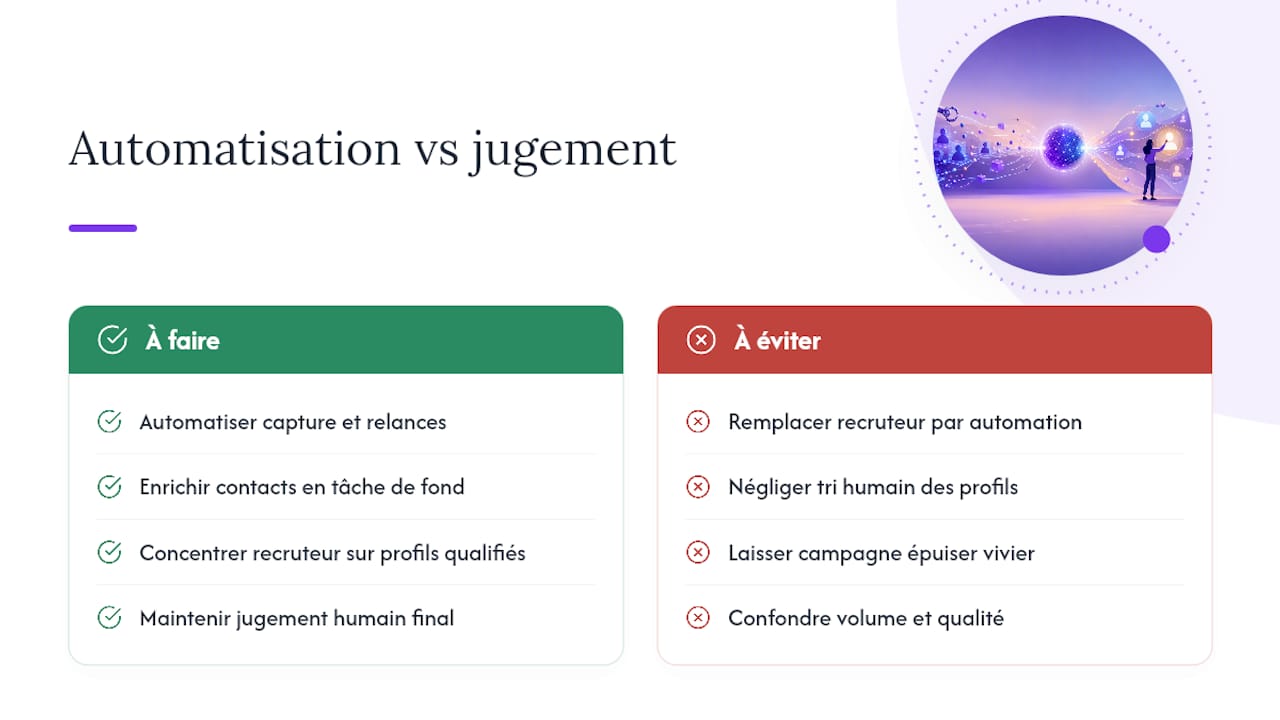
Randstad Appel Medical rolled out this kind of approach to speed up sourcing for healthcare profiles, an industry where the candidate shortage makes every minute of delay costly. The result is not just a gain in volume: it is the ability to focus human time on candidates who are already qualified, while capture, enrichment and first-level follow-ups run in the background.
It is this balance that separates a high-performing campaign from one that exhausts its talent pool. Automation never replaces a recruiter’s judgment on an interesting profile, it simply gives them the time to exercise it.
Jules
How Kalent simplifies running these campaigns
Building a short, targeted, multichannel sequence requires tools that talk to each other, not three different pieces of software to sync manually. The Kalent talent search engine lets you filter more than 200 million profiles by precise ICP criteria, while data enrichment gives access to 80 % of mobile numbers and 60 % of personal emails to prepare the multichannel switch without any extra manual step.
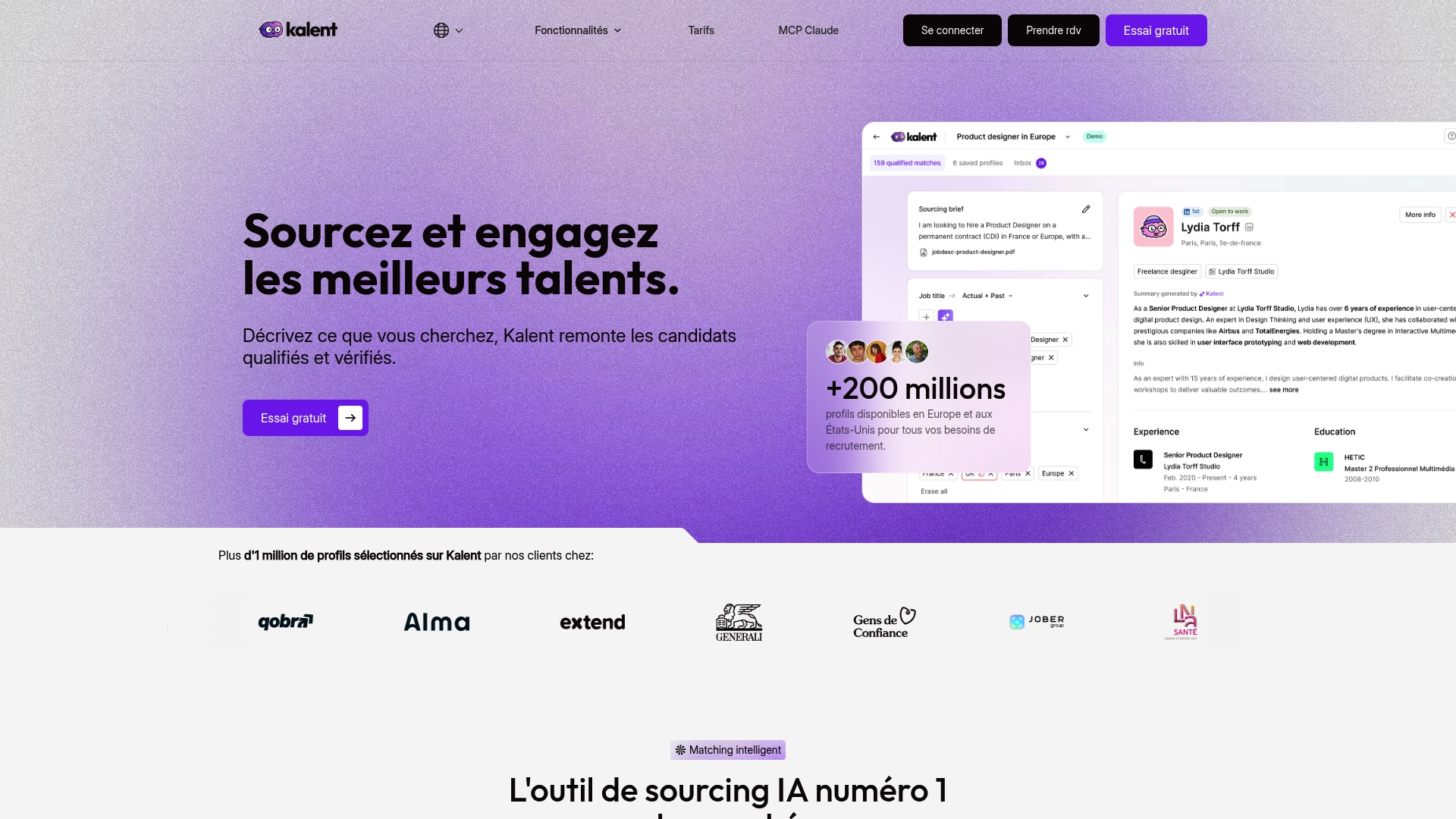
Kalent’s automation handles capture, enrichment and follow-ups across LinkedIn, email and WhatsApp from a single interface connected to your ATS, with sourcing time savings estimated at 50 %. The Randstad Appel Medical use case shows this rollout at the scale of an agency network. To test the mechanism on your own targeting criteria, book a Kalent demo and assess the concrete gain on your next talent pool.
Sources
Frequently asked questions
How many follow-ups should you send in a LinkedIn recruiting sequence?
Two follow-ups at most are enough, the first at D+3 and the second at D+7; beyond that, the reply rate drops and the risk of wearing out the candidate outweighs the benefit.
When should you move a LinkedIn conversation to email or WhatsApp?
As soon as a candidate shows a clear sign of interest, a positive reply or a question about the role, you should switch to a direct channel after running a compliance check on the enriched contact details.
What reply rate should you aim for on a LinkedIn recruiting campaign?
Recruiting benchmarks exceed the platform’s overall average, and good signal-based targeting can push the reply rate well above conventional sales standards.
Should you fully automate the first outreach message?
No: keep the first message and the follow-ups personalized and carefully written, and reserve automation for capture, enrichment and reminder tasks.
How do you avoid duplicate follow-ups between several recruiters?
A workflow connected to the ATS, like the one offered by Kalent, centralizes each candidate’s history and prevents two recruiters from following up with the same profile in parallel.


