Recruitment sourcing prompts: the ready-to-use library
Access a library of prompt templates for HR sourcing, organized with GDPR and AI Act safeguards, and integrated through Kalent.

Here we bring together ready-to-copy recruitment sourcing prompts, organized by stage of the process: profile search, outreach, CV screening, summaries for managers and interview preparation. Each prompt comes with its variants, a simple testing protocol and the GDPR and AI Act safeguards to respect. We also show how these prompts fit into a tooled workflow, with Kalent as a concrete example of automating sourcing and outreach.
In short:
- It is essential to test each prompt on a sample of profiles to avoid drift, in particular by excluding any inference about age or origin.
- The best integration includes automation via an API or a SaaS platform, while respecting contact limits and data retention rules under the GDPR.
- Prompts must be adapted to the precise context, such as seniority or tech stack, to keep them relevant and avoid generic results.
- Compliance with the GDPR and the AI Act requires transparent information for candidates, documentation of sources and management of access rights.
- Even with automation, a human review is essential before any rejection or decision, to guarantee the quality and legitimacy of the process.
Table of contents
- A library of prompts organized by recruitment stage
- Detailed examples: prompts in context and variants
- How to adapt, test and govern your prompts
- Integrating these prompts into your tools and workflow
- Compliance and best practices: GDPR, AI Act and CNIL recommendations
- What we see in the field: feedback and limits
- Automate sourcing and outreach with Kalent
- Frequently asked questions
- Sources
A library of prompts organized by recruitment stage
Recruitment time is first and foremost screening time: before convincing a candidate, you have to find them, qualify them, then know how to present them to a manager. So we organize our prompts according to these five moments of sourcing, each with its own logic.
Discovery and qualification prompts
These prompts turn a job description into a usable search query and surface variables a recruiter might forget.
- Ask the AI to rephrase a job description into ten alternative Boolean keywords, including job synonyms and title variants.
- Have it list the certifications, tools or frameworks implied by a given technical role, to enrich the search criteria.
- Use a prompt that crosses industry, target company size and years of experience to refine a typical candidate profile before searching.
Personalized outreach message prompts
For outreach, the quality of a message depends on real personalization, not generic phrases pasted onto a first name.
- A LinkedIn prompt that builds on a specific achievement in the candidate's profile and links it to a concrete challenge of the role.
- A longer email prompt, which introduces the company in two sentences, then asks an open question rather than sharing an application link.
- A WhatsApp prompt, deliberately short, designed for a contact already engaged elsewhere in the process.
Pre-screening and CV summary prompts
Here, the key is a consistent output format, so that two CVs processed at different times remain comparable.
- Ask for a summary structured in five fixed fields: relevant experience, key skills, gaps relative to the role, questions to ask, indicative score out of five.
- Have two CVs compared on the same criteria, without ever having the candidate's age, gender, origin or health status mentioned.
- Ask for a list of points to check in the interview rather than a binary accept or reject decision.
Prompts for interview guides and scorecards
A well-built prompt generates a set of questions aligned with the skills actually sought, not a generic list found online.
- Ask for behavioral questions tied to a specific skill, with a three-level scoring grid.
- Have it generate technical questions graded by difficulty, adapted to the stated seniority of the role.
To personalize each of these prompts, always specify four variables: the industry, the target seniority level, the tech stack or business tools involved, and the working language or languages. A prompt written for a senior developer role in fintech will not produce the same quality of result if it is reused as is for a junior customer service role in insurance.
Detailed examples: prompts in context and variants
Three scenarios show how the same prompt evolves depending on the context and how to judge whether the generated output is usable.
- Senior back-end engineer. The initial prompt asks for a list of fifteen keyword combinations based on a given stack (Python, Django, PostgreSQL) and a seniority of seven years or more. A first variant widens the search to related frameworks (FastAPI, Flask) to capture adjacent profiles. A second variant narrows it to candidates who have mentioned experience with scaling, often a sign of genuine seniority. The evaluation criterion: at least half of the proposed combinations must match job titles actually used in the market, not theoretical labels.
- Conversational pre-qualification. The script asks the AI to generate three open questions for a first exchange, followed by a follow-up rule adapted to whether the candidate's answer is vague, negative or enthusiastic. The common mistake is letting the script move straight on to an interview proposal without intermediate human validation, which can put off a poorly qualified candidate or, conversely, rule out a good one too quickly.
- Summary for the hiring manager. The expected deliverable fits on half a page: context of the role, three shortlisted candidates with one paragraph each, then a recommended priority order for interviews. The required input is the full job description plus the pre-screening notes, never the raw CVs, so the manager does not receive a mass of unfiltered data.
Pro tip: Always ask the AI to justify its relevance score in one sentence: if it cannot explain it simply, the score is probably not reliable.
How to adapt, test and govern your prompts
A prompt that works once does not necessarily work the next time. We recommend a light but systematic protocol.
- Test each new prompt on a sample of at least ten profiles before rolling it out, comparing two versions on the relevance of the results and the response rate obtained.
- Keep a version log for each prompt: date of change, author, reason for the change and result of the next test.
- Always include a clause excluding any inference about age, gender, origin, disability or health status in screening and scoring prompts.
- Periodically review the generated outputs to spot gradual drift, for example a bias favoring one type of school or background over another.
The simplest rule to remember: no automatic rejection without human review, whatever score the AI assigns.
Pro tip: Keep a copy of the prompts that performed poorly: they are often more instructive than the ones that worked on the first try.
Integrating these prompts into your tools and workflow
Integrating a prompt generally follows three steps: first, manual use in a chat interface, then a call through an API to automate a recurring task, and finally full integration into a SaaS sourcing platform that orchestrates search, enrichment and outreach.
- On LinkedIn, respect daily contact limits and space out follow-ups to avoid being reported.
- On email and WhatsApp, a message that reads as too automated is quickly spotted: keep a minimum of variability even in AI-generated templates.
- Keep an exportable history to your ATS for every exchange generated by a prompt, to track who was contacted, when and with which message.
- Respect the retention period for application data, generally limited to two years after the last useful contact.
Tools like RecrutFlo automate the intake and structuring of CVs received by email, which can feed a sourcing engine upstream. On our side, the talent search engine and the conversational agent we offer let you move from an isolated prompt to full multichannel automation, with no script to maintain yourself.
Compliance and best practices: GDPR, AI Act and CNIL recommendations
Using AI for sourcing does not exempt you from any existing obligation, and even adds new ones. The European AI regulation classifies recruitment systems that use AI as high-risk systems, which brings obligations around transparency, risk management and technical documentation.

The CNIL specifies that the people concerned must be informed, including about the categories of sources used to train the models, with publication of an information notice when individual notification is not possible.
In practice, this means:
- Writing a clear notice stating the purpose of the processing, the categories of data collected and how long they are kept.
- Documenting the sources used for collection or training, in line with the expectations detailed in the CNIL recruitment guide.
- Guaranteeing candidates' rights of access, rectification and objection over the data processed by AI.
- Planning a periodic audit of the generated outputs, with the structural impossibility of an automatic rejection without human review.
What we see in the field: feedback and limits
Well-calibrated prompts save real time on initial screening, but they often fail on the nuance of an atypical background that an experienced recruiter would have known how to value. Before any rollout, check five points: the clause excluding protected criteria, the consistency of the output format, version traceability, the presence of a mandatory human review, and a test on a representative sample for the target role.
Jules
Automate sourcing and outreach with Kalent
A good prompt is still limited by the pool of profiles it works on. We built Kalent to solve this problem upstream: our talent search engine gives access to more than 200 million profiles in Europe and the United States, with data enrichment that makes it easier to reach mobile numbers and personal emails.
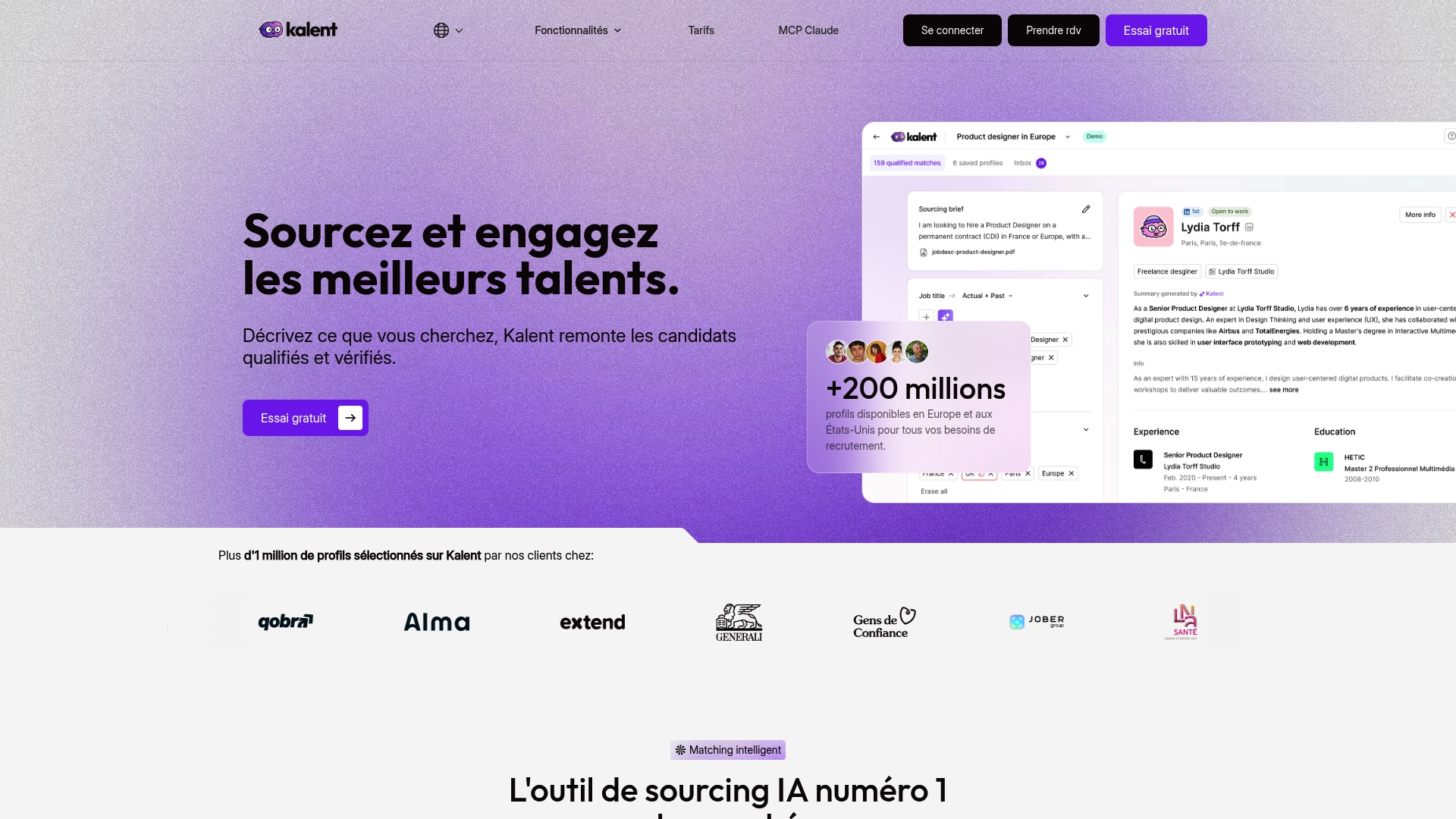
Once the profiles are identified, our automated outreach features relay your outreach prompts on LinkedIn, email and WhatsApp from a single interface, while keeping a usable record for export to your ATS. The Sourcing plan starts at €79 per month, and the Copilot plan at €119 per month, both available by checking our pricing page. If you would rather see how it works before choosing a plan, you can book a demo and test the engine directly on your own job criteria.
Frequently asked questions
What is the best sourcing software for recruitment?
There is no single tool suited to every context: the choice depends on the volume of profiles sought, the preferred contact channels and the level of automation desired. Platforms like Kalent stand out for their access to a large base of enriched profiles and multichannel outreach automation, which reduces the time spent on repetitive sourcing tasks.
What are the right questions to ask a recruiter?
A candidate benefits from asking about the concrete day-to-day reality of the role, the reasons the previous person left, the evaluation criteria for the probation period, the makeup of the team and the medium-term career prospects. These questions often reveal more than the job description itself.
What is the most famous quote about recruitment?
It illustrates well the tension between objective data and human judgment in any sourcing process.
What are the stages of recruitment?
A recruitment process generally follows four main stages: defining the need and the profile sought, sourcing and qualifying candidates, interviews and assessment, then the decision and onboarding. Each stage now benefits from specific prompts that speed up the work without replacing the recruiter's judgment.
Do AI sourcing prompts comply with the GDPR?
A prompt in itself is neither compliant nor non-compliant: it is how it is used, in particular how candidates are informed and how long data is kept, that determines compliance with the GDPR and the European AI regulation. The CNIL recommends a clear information notice and documentation of the data sources used.
Sources
- Recruitment guide: the fundamentals of personal data protection, and questions and answers
- AI: Informing the people concerned | CNIL
- World’s First AI Law: EU Announces Provisional Agreement on AI Act | EEAS