
A 6-step sourcing workflow to hire faster
A six-step sourcing workflow to hire faster, get more replies and automate screening with templates.

An effective sourcing workflow fits into six steps: manager brief, channel selection, query building, personalized outreach, fast qualification and talent pool nurturing. This sequence cuts sourcing time and improves response rates when it rests on well-designed automation. Below you will find the detail of each step, concrete templates and a customer case showing how a platform like Kalent makes this process operational.
In short:
- Initial profile search and contact enrichment are handled efficiently by AI, significantly reducing sourcing time.
- Personalizing the automated message is crucial to improving the response rate, by targeting a concrete element of the candidate's background.
- Connecting the sourcing tool, the CRM or ATS, and the contact channels ensures smooth, GDPR-compliant automation.
- A six-step workflow, from defining the need to nurturing, optimizes each phase of recruitment so you can quickly adjust the strategy based on results.
- Integrating a single platform like Kalent lets you quickly test the impact on the pipeline with a short pilot, measuring response, lead time and time freed up.
Table of contents
- What can an AI agent really automate in your sourcing?
- The sourcing workflow step by step, from defining the need to the talent pool
- How should you split your efforts across channels, and which KPIs should you track?
- How do you connect AI to your CRM or ATS to automate outreach?
- What a customer case reveals about the real effectiveness of an automated workflow
- Why sourcing automation does not remove the need for human governance
- How Kalent puts this workflow into practice in your everyday tool
- Sources
- Frequently asked questions
What can an AI agent really automate in your sourcing?
An AI agent is not just an improved Boolean filter. A Boolean filter runs a query you wrote; an AI agent interprets a need, cross-references several databases, enriches the profiles it finds and can trigger automated outreach actions. An ATS, for its part, remains a system for managing the applications you receive: it does not go looking for profiles that never applied to you. Confusing these three tools explains a good share of the miscalibrated expectations about what AI can really change in your process.
What AI automates well today is fairly specific. Initial search across large volumes of profiles, contact enrichment, sending multichannel message sequences and tracking replies are repetitive, structured tasks where automation brings a direct time saving. An AI-driven talent search engine can, for example, match job criteria against millions of profiles and suggest a relevant ranking in a few minutes, where a recruiter would spend hours manually sorting LinkedIn results.
What remains, and will remain, a human job:
- Assessing real motivation and cultural fit during an interview.
- The final call between several candidates with equivalent profiles on paper.
- Salary negotiation and handling the candidate's objections.
- Fine-tuning the brief when the manager changes their mind mid-process.
AI excels at reducing noise upstream so the recruiter spends their time on the decisions that matter, not on sorting resumes. In practice, integration happens at three levels in your stack: the CRM or ATS that centralizes applications and contact history, the enrichment tools that fill in missing contact details, and the contact channels (LinkedIn, email, WhatsApp) where automated sequences run. The choice is not about replacing one with another, but about connecting these three building blocks so that information entered once flows everywhere without re-entry.
The sourcing workflow step by step, from defining the need to the talent pool
A sourcing workflow that works follows a linear logic, even when task execution is automated. Here are the six steps to run through for each open position.
1. The manager brief, in 30 to 45 minutes
Everything starts with a short but structured conversation with the hiring manager. The goal: leave that meeting with 5 to 7 clearly identified "must-have" skills, not a list of twenty wishes that are impossible to prioritize. A well-run brief also sets measurable goals from the start: how many qualified candidates are expected in a week, what the real salary budget is, how much room there is to negotiate on the minimum experience required. Skipping this step or rushing it in ten minutes costs a lot later, when you have to go back to the manager to rephrase poorly framed criteria after already contacting fifty profiles.
2. Choose and prioritize channels
Once the need is framed, you have to decide where to search. The answer is almost never "a single channel". A multichannel strategy systematically outperforms the single-channel approach, notably because each channel reaches a different segment of the job market: active candidates on job boards, passive ones on LinkedIn, and an often overlooked high-quality pool, current employees ready to refer.
3. Build robust queries
This is the technical step of effective sourcing: translating the brief's criteria into usable search queries. An AI-powered search engine handles this rephrasing work automatically, by interpreting the intent behind a natural language search rather than requiring perfect Boolean syntax.
4. Personalize the outreach
The generic message is the leading cause of sourcing failure, by far. Generic templates often fail from the very first sentence, because the candidate immediately spots a message sent to a hundred people at once. Personalizing the hook on a concrete element of the candidate's background, a project mentioned on their profile, a previous company, clearly changes the response rate.
Pro tip: Write three hook variants for each campaign (one focused on the candidate's project, one on career growth, one on team culture), then let the first replies tell you which one converts best before rolling it out.
5. Qualify quickly in the ATS or CRM
Every positive reply should be scored and tagged immediately, not handled at the end of the week in a pile of unread messages. A simple scoring system (hot, warm, cold) combined with skill tags lets you prioritize callbacks and avoid a highly qualified candidate waiting five days for a reply while a recruiter processes files in order of arrival rather than order of relevance.
6. Nurture the talent pool over time
Not every interesting candidate is ready to move right away. Structured nurturing, with a regular contact cadence over about 90 days and content adapted to each segment of the pool, turns cold profiles into candidates available at the right time. An unmaintained talent pool goes stale fast: contact details change, career priorities shift, and the candidate who seemed open six months ago has often already signed elsewhere.
- Manager brief (30 to 45 min, 5 to 7 must-have criteria)
- Selection of priority channels based on how rare the role is
- Query building and first screening
- Personalized multichannel outreach
- Qualification and scoring in the ATS/CRM
- Nurturing and upkeep of the talent pool
How should you split your efforts across channels, and which KPIs should you track?
For a common role, job boards and active sourcing are often enough. For a rare or senior position, referrals become decisive: referral hires are generally faster and show better retention than hires from a cold channel.
A mix that works for most positions looks like this:
- A significant share of the effort on active sourcing (LinkedIn, resume databases, direct search).
- A notable share on passive sourcing (approaching candidates who are not job seeking, reactivated internal pool).
- A large proportion on referrals and internal recommendations.
The mix that matters: a multichannel sourcing plan with about a quarter referrals in the pipeline generally optimizes overall conversion rates, because these candidates arrive already pre-qualified by the trust of the employee who recommends them.
On job boards, what counts is the volume of qualified applications per week. On referrals, the key KPI is the time between the recommendation and the first interview, which must stay short so as not to discourage the employee who made the referral.
Auditing an underperforming channel follows a simple logic: start with the first line of the message before questioning the targeting itself. An audit run from the second week the position is open lets you adjust course before time to hire stretches dangerously, a principle that applies as much to tight management of a sourcing pipeline as to any operational process measured over short cycles.
How do you connect AI to your CRM or ATS to automate outreach?
The technical architecture of an automated sourcing workflow always follows the same logic, whatever the tool chosen: source, enrichment, scoring, sequence, follow-up. Each building block feeds the next, and a break anywhere in the chain (unenriched contact details, missing scoring) breaks the automation downstream.
Technical integration relies on three types of connections. APIs let your sourcing tool send qualified candidates straight to your ATS without manual export. Webhooks trigger actions in real time, for example launching an outreach sequence as soon as a profile reaches a minimum score. Native connectors to the ATS on the market avoid custom development and reduce the risk of sync errors between systems.
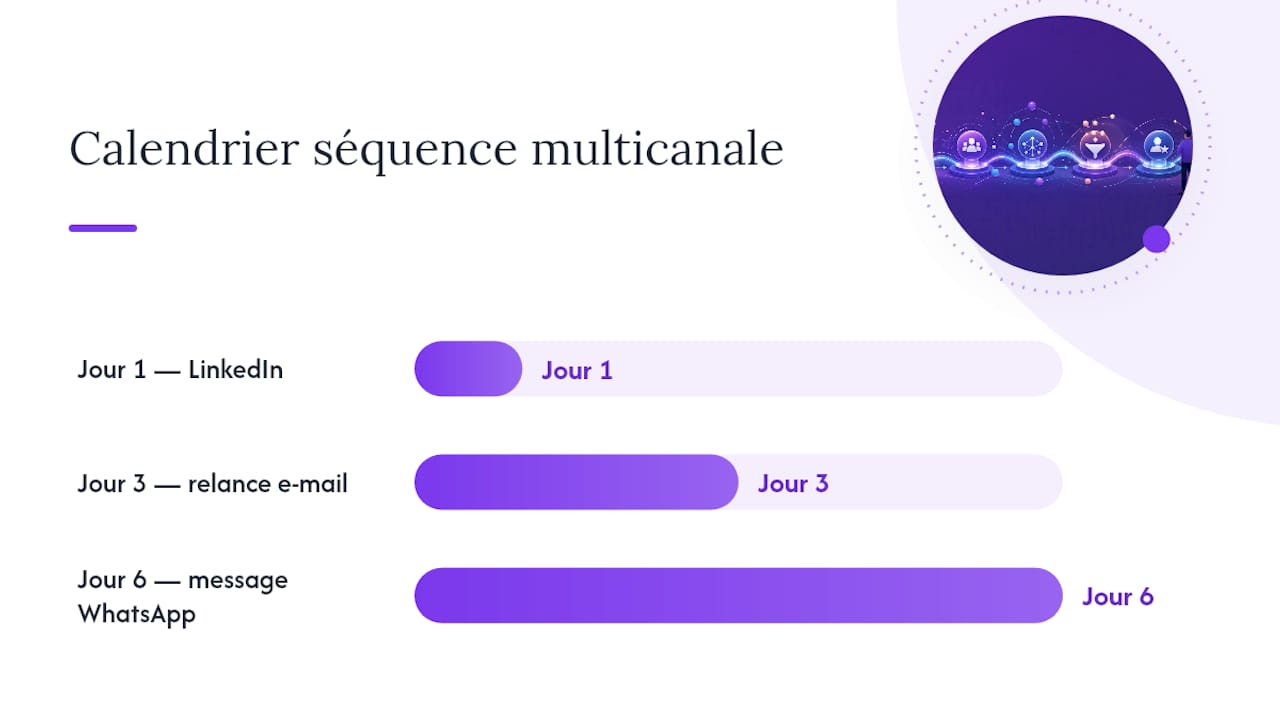
A typical multichannel sequence is built over several days. Never in a single bulk send:
- Day 1: first personalized message on LinkedIn.
- Day 3: email follow-up if there is no reply, with a different angle.
- Day 6: WhatsApp message for profiles whose mobile number is available, often more effective at capturing attention.
- Stop rule: after three attempts with no reply, the profile automatically moves into the nurturing pool rather than being contacted indefinitely.
Pro tip: Set a strict stop rule in your sequence. A candidate followed up six times without replying is not suddenly going to change their mind: they are more likely to feel harassed, which hurts your employer brand well beyond this specific position.
On the compliance side, an automated sourcing workflow handles personal data at scale, which calls for particular vigilance with regard to GDPR. The candidate's consent to the processing of their data must be traceable, the retention period for profiles in your database must be defined and respected, and storage must stay limited to the information actually needed for recruitment. Centralizing information in a structured tool makes this traceability easier, by preventing candidate contact details from ending up scattered across Excel files or individual inboxes that are impossible to audit in the event of an access or deletion request.
For teams handling large recruitment volumes, external resources on operational management tools for recruitment agencies give a useful overview of management software adjacent to pure sourcing, notably for invoicing and financial tracking of assignments.
What a customer case reveals about the real effectiveness of an automated workflow
The theory of a six-step workflow is only worth something if it holds up against a real volume of hires. Kalent, an AI-powered sourcing platform, gives access to more than 200 million qualified profiles in Europe and the United States, with an enrichment rate reaching 80% for mobile phone numbers and 60% for personal emails on the profiles searched. This coverage directly changes step 4 of the workflow described above: without reliable contact details, personalized multichannel outreach remains theoretical.
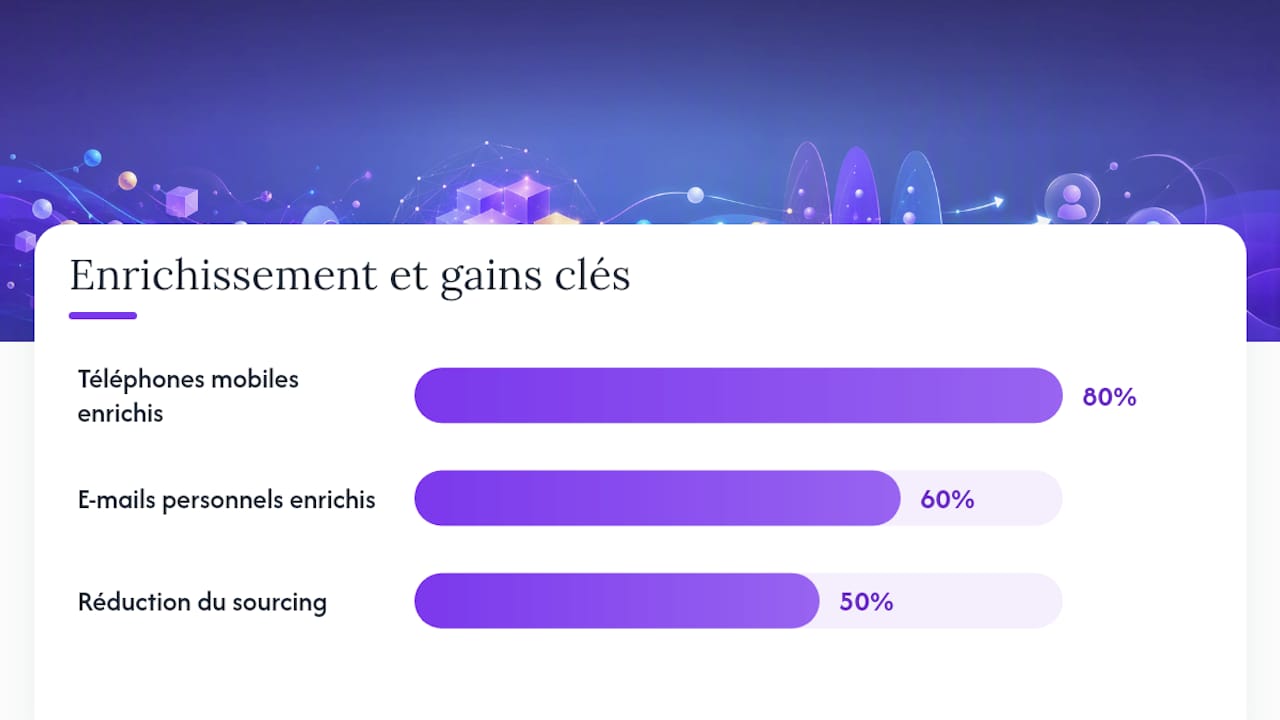
The case of FAB Group illustrates what this kind of architecture concretely changes in a high-volume recruitment pipeline. Automating outreach via LinkedIn, email and WhatsApp, combined with data enrichment, cut sourcing time in half for the teams involved, a gain that comes less from a miracle algorithm than from removing repetitive manual tasks: looking up contact details, copy-pasting messages, forgotten follow-ups.
Before adopting an AI sourcing tool, a serious buyer checklist should cover several concrete criteria:
- The database's real coverage of your geographic market and target sectors.
- The actual contact enrichment rate, not just advertised but verifiable on a sample.
- The quality of native integrations with your existing ATS or CRM.
- The ability to manage several contact channels from a single interface.
- GDPR compliance guarantees on the storage and processing of candidate data.
- The availability of a trial or demo before contractual commitment.
Why sourcing automation does not remove the need for human governance
The most common mistake among teams adopting an automated sourcing workflow is believing the tool replaces strategic thinking. It never does. AI speeds up execution; it does not fix a poorly framed brief or a weak employer value proposition: a perfectly personalized message sent for an unattractive position will not convert better than a generic template.
The healthiest rollout follows a gradual ramp-up. Start with a pilot on a single team or a single type of position for four to six weeks, measure conversion KPIs by channel, then expand only if the numbers confirm the gain. Jumping straight to a massive rollout across all open positions, with no test phase, prevents you from identifying what really works in your specific context.
Data governance deserves as much attention as performance. Who has access to enriched contact details, how long they are kept, who approves message sequences before they are sent automatically: these questions must be settled before launch, not discovered after a first compliance incident. Finally, successful adoption depends on involving recruiters themselves in configuring sequences, not on a mandate from leadership with no training or explanation of the reasoning behind each automated step.
Jules
How Kalent puts this workflow into practice in your everyday tool
Kalent is the direct option for anyone who wants to apply this workflow without building the technical architecture themselves: a single platform brings together search across more than 200 million profiles, automatic contact enrichment and sending multichannel sequences, where other approaches force you to connect several separate tools and manually manage the handoffs between them.
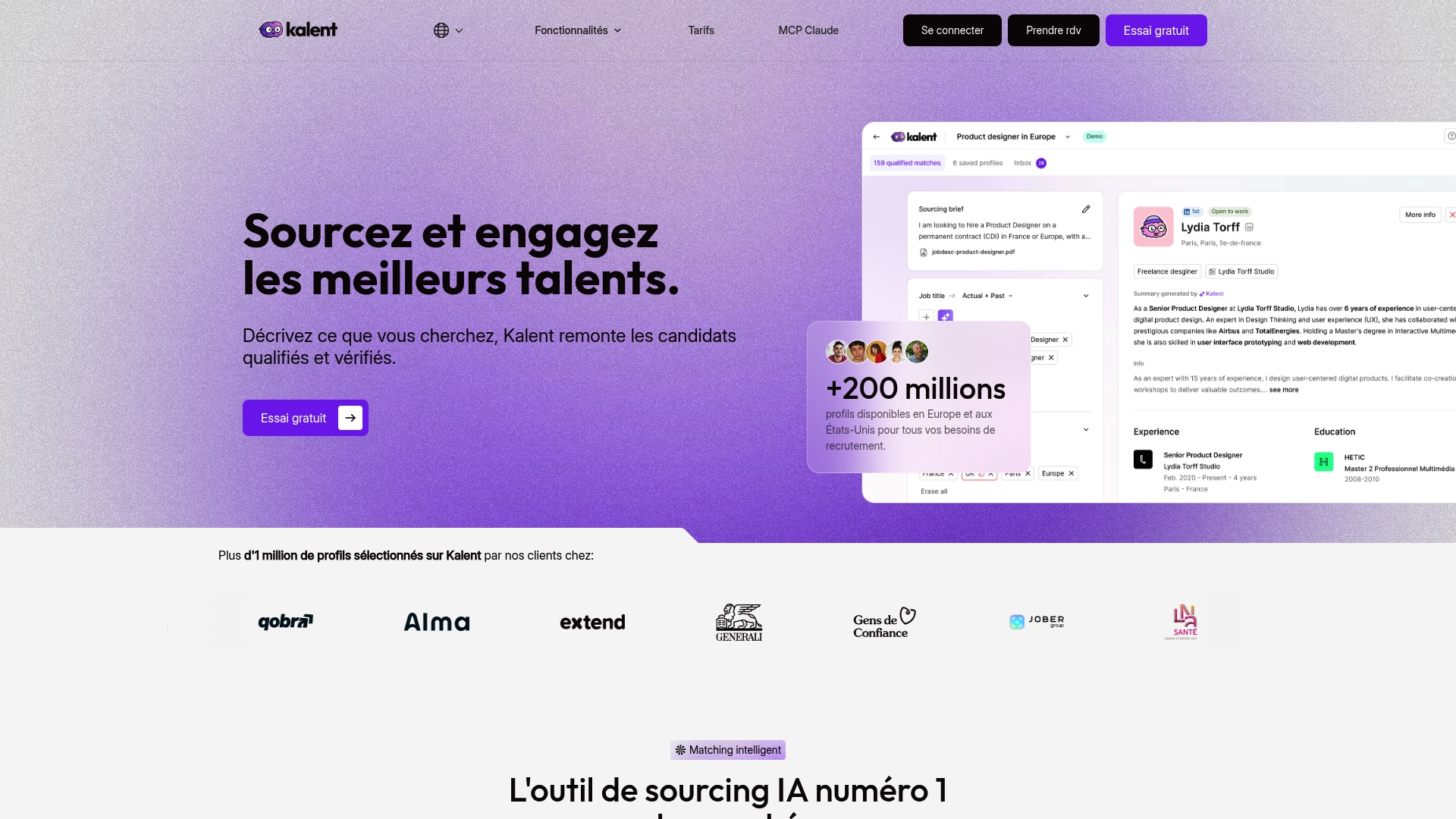
In practice, such a platform can automate outreach via LinkedIn, email and WhatsApp and help reduce the time spent on sourcing for the positions tested. To assess the impact on your own pipeline, a 30-day pilot on one team is generally enough to measure three key indicators: response rate by channel, average time to the first qualified interview, and recruiter time freed up for high-value tasks. The talent search engine and data enrichment work together from the very first search, with no heavy technical setup. To see the workflow in action on your own open positions, book a Kalent demo.
Sources
The guides cited in this article each cover a specific aspect of sourcing: structuring into steps and the length of the manager brief on Lucca, building a multichannel plan with referrals on commerces-mairie.fr, and message personalization techniques on Flatchr.
To go further on the tooling side, Kalent's data enrichment page details how contact qualification works technically, and the article 10 ways to use AI in recruitment offers use cases that complement those covered here.
- Candidate sourcing: 6 steps to a successful strategy in 2025
- Creating a multichannel sourcing plan: LinkedIn, job boards, referrals, schools
- Recruitment sourcing: 5 key steps and 6 highly effective hacks
- Supplier audit and supply chain optimization
Frequently asked questions
What exactly is a sourcing workflow?
A sourcing workflow is the structured sequence of steps that runs from defining the need with the manager to building a pool of qualified candidates, through searching for, approaching and qualifying profiles.
What are the different types of sourcing in recruitment?
There are mainly active sourcing (candidates who apply or are approached directly), passive sourcing (profiles not job seeking that are identified and then contacted) and referrals, which rely on recommendations from internal employees.
What are the 4 key stages of recruitment?
The four main phases are generally candidate sourcing, pre-screening and qualification, interviews, then the decision and onboarding. Sourcing itself then breaks down into six detailed steps, from the manager brief to nurturing.
How do you run effective sourcing day to day?
Effective sourcing combines a precise manager brief upfront, a multichannel strategy rather than a single channel, personalized messages from the first contact, and tracking KPIs by channel from the second week to adjust quickly.
Can Kalent automate this entire workflow?
This solution automates search, contact enrichment and sending multichannel sequences, but final qualification and the hiring decision remain the recruiter's responsibility. Pricing information is available on the dedicated site.


