
Talent mapping: the method to anticipate your talent needs
Talent mapping crosses internal and market skills to anticipate needs, prioritise hires and cut the hiring delay.

Talent mapping is the structured mapping of internal and external skills that lets you anticipate your talent needs and reduce time-to-hire. In practice, it means crossing a skills framework with performance, potential and market data to know where your strengths are, where your gaps are, and who to hire first. This approach relies on tools that have become classics in HR: the 9-box matrix, 360 degree feedback, assessment centers. Kalent, a sourcing platform powered by AI, is a good illustration of how technology speeds up this data collection today.
In short:
- Internal and external talent mapping lets you anticipate skills needs and reduce the hiring delay, especially for rare profiles.
- The skills-based approach is more relevant than the job-based one to target the real capabilities of teams from the start.
- Visualising with 9-box matrices or heatmaps makes it easier to prioritise development or hiring actions.
- Data collection relies on internal sources (HRIS, feedback) and external ones (market, databases, AI), while respecting the GDPR.
- Using AI tools such as Kalent speeds up the search for profiles and their enrichment, for an effective external mapping.
Table of contents
- What is talent mapping and what does it really cover?
- What concrete benefits for the company?
- How to build an operational mapping step by step?
- Which visualisation models should you choose to read your data?
- Which sources and tools should you use to collect the data?
- Which indicators should you track to measure the effectiveness of the mapping?
- A practical checklist to start your first pilot
- How does an AI platform like Kalent speed up data collection?
- What the field teaches about rolling out talent mapping
- Testing a solution to speed up your external mapping
- Sources
- Frequently asked questions
What is talent mapping and what does it really cover?
Talent mapping plays out on two fronts. Internal mapping inventories the skills, the performance and the potential of your current teams. External mapping scans the market: where the rare profiles are, at which competitors, with what availability. Combined, these two sides feed workforce planning, rather than a simple up to date CV database.
Another distinction shapes the exercise: the skills-based approach against the job-based approach. The first maps what people know how to do, the second what function they hold. Talent mapping becomes useful in three precise situations:
- You are preparing a medium term workforce plan and need to anticipate retirements or new roles.
- You want to smooth internal mobility before launching a costly external hire.
- You are starting a strategic hire on a rare skill (data science, cybersecurity, generative AI).
What concrete benefits for the company?
A well run mapping reduces the time and the cost of recruitment by targeting profiles in advance rather than reacting to an open role. Time-to-hire drops mechanically when you already know who to approach.
Talent mapping changes three directly measurable indicators:
- The average hiring delay on critical roles
- The retention rate of the high potentials identified upfront
- The number of successful internal moves before turning to the external market
The use cases speak for themselves. A company launching an artificial intelligence project knows, thanks to the mapping, whether it already has internal profiles able to lead the project or whether it has to source externally. Opening a center of excellence follows the same logic: you first identify who, inside the organisation, can form the initial core.
How to build an operational mapping step by step?
A mapping that stays in a spreadsheet with no follow up has no value. Here is the sequence that produces usable results:
- Frame the objective and the time horizon. Do you want to anticipate departures over twelve months, or prepare a transformation over three years?
- Build a shared skills framework. Without a common language between HR and managers, every assessment stays subjective.
- Collect internal and external data. HRIS, annual reviews, 360 degree feedback, but also market data on the availability of profiles.
- Run the gap analysis. Compare the available skills with the projected needs, role by role or team by team.
- Prioritise and build the action plan. Training, targeted hiring, or internal mobility depending on the type of gap identified.
- Set up governance and an update rhythm. A good mapping crosses current skills, potential, performance and aspirations to stay relevant over time, which implies a regular review, not a frozen exercise.
Which visualisation models should you choose to read your data?
The 9-box matrix remains the most widespread model: it crosses performance (horizontal axis) and potential (vertical axis) into nine boxes, from "to develop" to "future leader". The 4-box simplifies the exercise for teams that are just starting, by reducing the grid to four quadrants that are easier to discuss in a leadership committee. Skills heatmaps, for their part, visualise density by team or by site rather than by individual.
- The 9-box suits succession committees and formal talent reviews.
- The 4-box works well for a first pilot or a small team.
- The heatmap reveals the zones of collective fragility, useful to prioritise training.
Pro tip: Never calibrate your performance and potential scales on a single manager. Always have the ratings calibrated in committee, otherwise the same box of the matrix will not mean the same thing from one team to another.
Which sources and tools should you use to collect the data?
The mapping feeds on varied sources, internal as well as external. Internally, the HRIS remains the backbone: annual reviews, 360 degree feedback and assessment centers land there in theory, when the processes are properly fed. Externally, published job ads, public profiles and salary benchmarks give a snapshot of the market.
- HRIS modules to centralise performance and skills data.
- Talent intelligence platforms to cross internal data with market signals.
- AI enrichment solutions to automatically complete incomplete profiles.
- The public data from Pôle emploi makes it possible to assess the real availability of certain skills in a given employment area.
One last point cannot be neglected: GDPR compliance on every contact or assessment data point collected, including data enriched automatically by a third party platform.
Which indicators should you track to measure the effectiveness of the mapping?
A mapping without tracking indicators ends up as a cosmetic exercise. Focus on a limited number of metrics, followed regularly rather than on an exhaustive dashboard looked at once a year.
- Density of critical skills by unit or by team: how many people really master the rare skill identified.
- Time-to-fill by skill rather than a global time-to-fill, often too smoothed out to be actionable.
- Internal mobility rate and retention rate of the high potentials spotted in the 9-box.
- Ready-now pipeline: the number of profiles immediately available for a given critical role.
Talent mapping makes it possible to plan skills in the medium and long term precisely because it turns these indicators into early warning signals rather than after the fact observations.
A practical checklist to start your first pilot
There is no point aiming for exhaustiveness on the first attempt. A tight pilot, measurable in a few weeks, convinces better than a general mapping that drags on for six months with no deliverable.
- Appoint a sponsor and a clear governance, with an HR role and a business role.
- Choose one to three critical roles only for this first pilot.
- Select your data sources (HRIS, reviews, market) and a simple visualisation tool.
- Put together a minimal skills framework, even if you enrich it later.
- Run the gap analysis on this narrow scope.
- Set a calendar of talent reviews, quarterly preferably for critical skills.
- Document the decisions taken (training, hiring, mobility) to build a history.
- Review the pilot after a full cycle before extending the scope.
Pro tip: Resist the temptation to map the whole market from the start. A scope of twenty to fifty target companies (feeder companies) is largely enough to get usable market intelligence on a given role.
How does an AI platform like Kalent speed up data collection?
External mapping often runs into a simple problem: contact data is incomplete or out of date. Modern talent intelligence and AI tools automate the enrichment of profiles, which clearly reduces the time needed to prepare a shortlist.
Automating contact through LinkedIn, email and WhatsApp cuts sourcing time in half, a direct gain for the external mapping part of the process.
Before adopting such a tool to feed your mapping, ask three simple questions:
- Are the quality and the freshness of the data guaranteed by regular updates?
- Does the tool integrate with your existing ATS without double entry?
- Does the processing of contact data comply with the GDPR?
What the field teaches about rolling out talent mapping
Most talent mapping projects fail from too much ambition, not from a lack of method. Wanting to map an entire industry dilutes the effort and delays the first useful deliverable. Targeting twenty to fifty benchmark companies for a precise role produces results much faster. Another underestimated point: a quarterly review on critical skills is worth more than an annual update, because the market for rare talent moves faster than most classic HR cycles. Launch a measurable pilot, iterate, then widen.
Jules
Testing a solution to speed up your external mapping
A precise external mapping depends on one thing: the quality and the freshness of contact data. That is exactly where Kalent brings a concrete advantage over manual monitoring on LinkedIn or frozen databases.
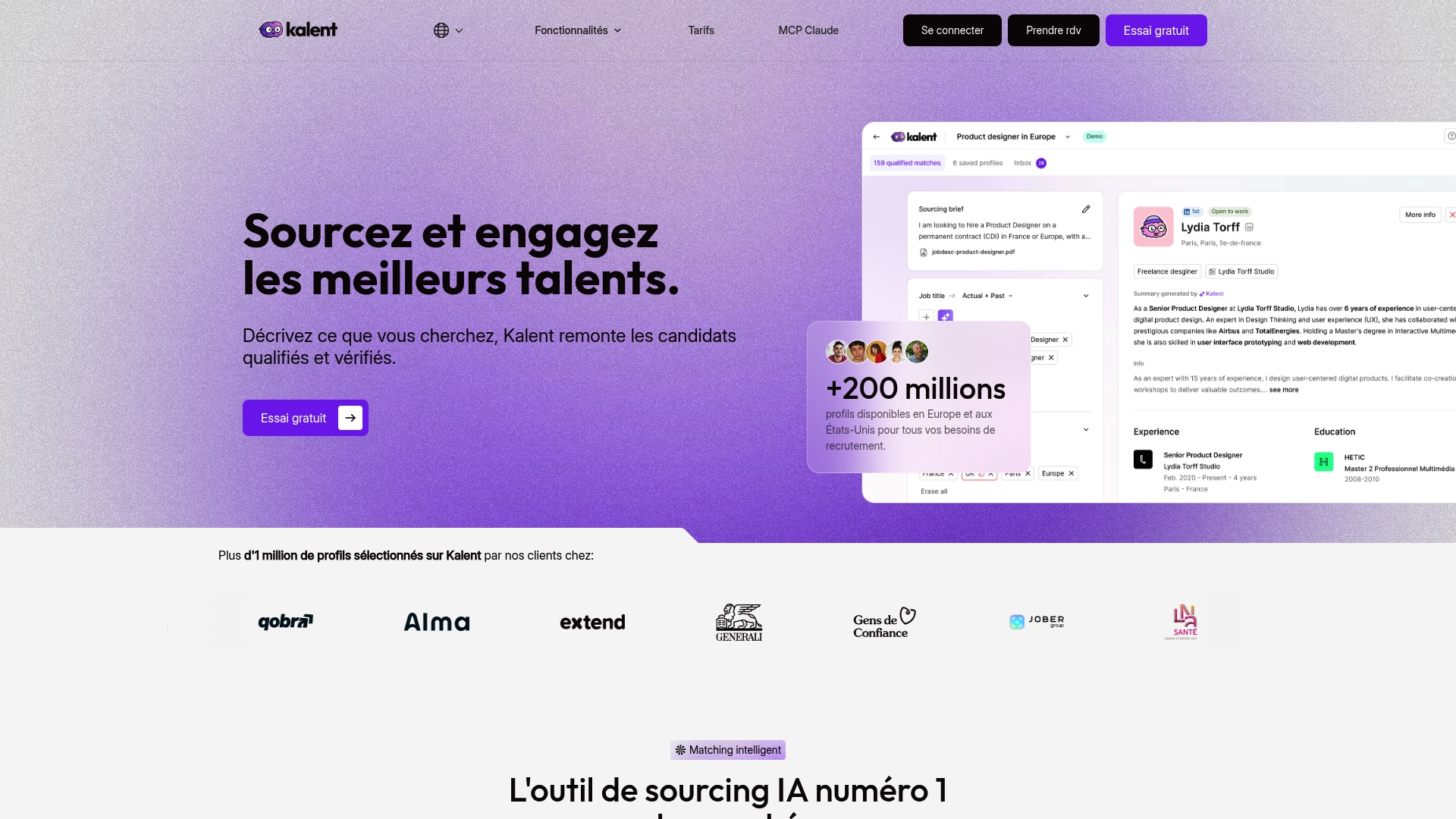
For an HR team building its external mapping, that means shortlists ready to contact rather than lists of names to qualify one by one. The Kalent talent search engine lets you filter directly on the skills of your framework, and data enrichment feeds your external mapping without manual collection.
Test the approach on a short pilot: select your two or three critical roles, measure the enrichment rate obtained and check the integration with your ATS. Book a demo to assess these capabilities on your own skills framework.

Sources
To go deeper into the method and calibrate your frameworks, the guides from Workday, CNFCE and Hyring detail models and steps. The data from Pôle emploi remains a solid reference to calibrate your salary benchmarks and assess the availability of skills in your employment area.
- Talent mapping: advice and templates to get it right | Workday FR
- Talent mapping: how to map the talent inside a company? | CNFCE
- What Is Talent Mapping? Process and Guide | Hyring
- Pôle emploi, workforce needs survey (BMO)
Frequently asked questions
What is mapping in HR?
Mapping, or talent mapping, means the structured mapping of the internal and external skills of an organisation, used to anticipate future needs and target the profiles to hire first.
What are the 4 pillars of human resources linked to mapping?
You generally find recruitment, skills management, internal mobility and workforce planning. Talent mapping relies on these four pillars to cross performance, potential and market data.
How do you carry out a talent mapping?
Start by framing a precise objective and a narrow scope, build a shared skills framework, collect internal and external data, then run a gap analysis followed by a prioritised action plan.
What are the different types of talent to map?
You generally distinguish high potentials with strong room to grow, experts holding rare skills, and key profiles for operational continuity. A talent intelligence platform helps qualify these profiles externally thanks to its enrichment data.


