
How long does hiring take in France in 2026?
Estimate how long hiring takes in France in 2026: benchmark figures and tips for a predictable process that spares candidates.

A well-run hiring process usually takes between 5 and an average duration of several weeks depending on the role, with an average close to an approximate average duration of several weeks for executive roles. Aim for a few weeks for a non-executive role and a longer time, often several weeks, for an executive role of average complexity. The number matters less than the clarity: a predictable process, even a slightly longer one, wears the candidate out less than a vague journey.
In short:
- The average time to hire an executive reaches several weeks, with a critical threshold of three weeks for the first contact that signals excessive slowness.
- The availability of internal decision-makers, especially managers on the road or committees, is the main brake on the speed of the process, and can add several days of delay.
- Limiting interviews to two or three, merging redundant steps and setting internal SLAs can significantly cut the delay without compromising selection.
- Regularly measuring four key indicators (total time, time to first contact, time between steps, conversion rate) pinpoints exactly what needs improving.
- Bringing automation and AI into sourcing generally cuts the time needed to find and contact candidates by 50 %, even if its use remains marginal for executive roles.
Table of contents
- Time to hire: definitions and benchmark figures
- What factors lengthen or shorten a hiring process?
- How do you measure time to hire step by step?
- Which levers cut time to hire for good?
- How do automation and AI speed up sourcing?
- Handling the unexpected without derailing the whole schedule
- Why HR/operations communication saves weeks
- Does time to hire vary with company size?
- Does training recruiters really change timelines?
- Concrete examples of successfully reducing time to hire
- Speed, quality and candidate experience: what comes first?
- Cutting sourcing time with Kalent
- Sources
- Frequently asked questions
Time to hire: definitions and benchmark figures
Three indicators are often confused even though they measure different things. Time to hire covers the period between a person's application and the signing of their contract. Time to fill starts when the role opens, not at the first application, which includes the upstream sourcing phase. Time to first contact isolates the delay between receiving an application and the recruiter's first reply, a point candidates watch especially closely.
Benchmarks vary widely by sector and contract type:
- The median time to hire in France hovers around a median of just over a month in France according to SmartRecruiters data.
- Executive hires take on average an average duration of several weeks, peaking at a noticeably longer duration in some sectors, such as industry in industry.
- Permanent (CDI) hires use more channels and take longer than fixed-term (CDD) hires, according to Dares.
Benchmark: a first contact beyond three weeks is considered excessive by a notable share of the executives surveyed by Apec. This threshold, more than the total duration, shapes how slow a process feels.
What factors lengthen or shorten a hiring process?
The availability of internal decision-makers remains the first bottleneck identified in most organizations. An approval waiting on the signature of a director who is traveling can cost two weeks on a file that HR has already wrapped up. Apec surveys also suggest that the recent stabilization of timelines owes more to organizational hurdles than to a shortage of candidates.
Several elements play a decisive role in the final duration:
- The number of interviews: 90 % of executives would prefer a process limited to 2 or 3 interviews at most, compared with 4 or 5 in some processes still in use.
- The type of role and contract: a permanent executive role involves more stakeholders than a fixed-term replacement.
- The nature of the tests required: a long case study or a motivation assessment slows conversion between steps.
- Radio silence between two interviews, which pushes the best profiles to accept a competing offer before they even hear back.
Transparent communication about timelines mechanically lowers the drop-off rate, even when the process remains objectively long.
How do you measure time to hire step by step?
Measuring before acting keeps you from fixing the wrong problem. Four indicators are enough to steer the essentials of a hiring process:
- Overall time to hire, from application to signature.
- Time to first contact, from application to the first human reply.
- The time between each step (HR interview, manager interview, test, offer).
- The conversion rate per step, which shows where candidates drop out.
Most ATSs let you set up a dashboard tracking these four metrics without any extra development. A weekly report, aligned with the rhythm of HR team meetings, is generally enough to spot a slip before it sets in.
Pro tip: set a target for each step and display it in your ATS: 72 hours maximum for the first contact, 5 days between two interviews, 48 hours for the final decision. A visible number gets respected better than a vague intention.
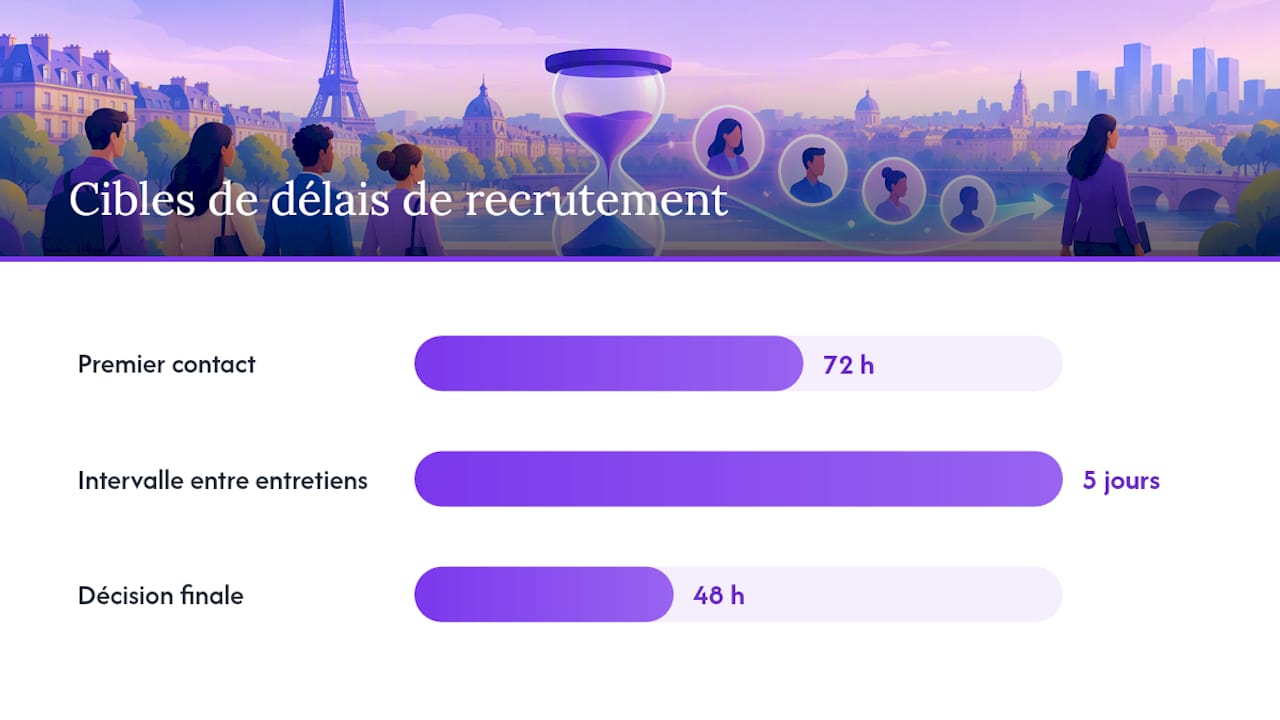
These targets are not arbitrary: they reflect what candidates themselves expect for the time to first contact, as measured by Apec.
Which levers cut time to hire for good?
Cutting the duration without sacrificing selection quality means tackling the right links, not all of them at once. Here are the five priorities that deliver the most effect for the least effort:
- Clarify the need before posting. A vague job description generates off-target applications that lengthen screening without improving the talent pool.
- Group interviews together. Merging two steps that assess the same decision (technical and team fit, for example) saves one to two weeks without losing rigor.
- Standardize assessment with a scorecard. A digital grid shared between recruiters and managers speeds up the collective decision, a point detailed by Randstad in its guide to an effective hiring process.
- Set internal SLAs. A commitment to reply within 72 hours after each interview, tracked and reminded automatically, changes team behavior more than a simple verbal instruction.
- Centralize scheduling. Bringing applications and availability into a single tool avoids the email back-and-forth that, on its own, often adds several days.
Other adjustments also tip the scales:
- Identify the criteria actually correlated with success in the role rather than piling up generic tests.
- Map the decision tied to each step and remove those that duplicate the same question.
- Give the candidate clear visibility on the remaining steps, a factor that lowers the drop-off rate according to Liane RH's recommendations.
Pro tip: before removing a step, always ask: what single decision does this step let us make? If the answer overlaps with an existing step, merge the two rather than keeping one out of habit.
How do automation and AI speed up sourcing?
Time to hire is decided first in the screening and first contact phase, before the first interview even happens. Organizations that bring AI into their process hire faster on average, saving about a quarter of the time compared with those that do without, a gap built mainly on sourcing and outreach.
Three functions account for most of the time saved:
- Automated multichannel sourcing, which widens the talent pool without multiplying manual searches.
- Contact data enrichment, which gives direct access to a personal phone number or email rather than a work address that is rarely checked.
- Automated follow-ups and scheduling, which remove the dead time between two exchanges.
This adoption nonetheless remains a minority practice for executive hiring, where AI tools are still not widespread according to Apec. One point calls for caution: automated messages must stay under human control on substance, and any collection of personal contact details must comply with the GDPR, notably regarding the legal basis for contact and the data retention period.
Handling the unexpected without derailing the whole schedule
A recruiter who drops out of the panel, a candidate who backs out, a budget frozen mid-process: the unexpected is part of the job. Good practice is to build a safety margin into the schedule from the start, rather than discovering the need for one in a rush halfway through.
In practice, this means keeping a second slot available for each key interview, naming a stand-in for every decision-maker absent more than five days, and agreeing to postpone a step rather than skip it under pressure. A manager interview canceled without immediate rescheduling often costs more time than a postponement clearly announced to the candidate.
The most useful margin remains the contact buffer: keeping two or three profiles in reserve in the talent pool lets you absorb a withdrawal without restarting sourcing from scratch. This is where centralizing applications in a single tool makes a real difference, since it avoids rebuilding a list of available profiles in a hurry.
A schedule adjustment is not a failure of method. It is a signal to communicate quickly, to the candidate as well as to internal teams, so that uncertainty does not set in and stretch the timeline even further.
Why HR/operations communication saves weeks
Most delays do not come from the recruiter but from waiting for feedback from the operational manager. A poorly aligned brief upfront, where the real need behind the role stays vague, is paid for later in back-and-forth over the profiles presented.
A short, weekly sync between the HR team and the hiring manager prevents this. This meeting should cover only three things: the profiles under evaluation, the decisions pending on the manager's side, and the blockers to clear before the next interview. A written summary, even two lines long, is better than a verbal exchange that is quickly forgotten.
Sharing a common dashboard, visible to both sides, also reduces friction. When managers see for themselves that three candidates have been waiting for their approval for four days, nobody needs to remind them by email. This shared visibility turns a chasing relationship into a tool for self-discipline.
The stakes go beyond speed: a manager poorly informed about the calendar ends up offering late slots or revising criteria along the way, which stretches the process well beyond the initial delay.
Does time to hire vary with company size?
A small company often decides faster than a large group, since it lacks a multi-level approval circuit. The head of an SME who meets the final candidate in person can decide within 48 hours, while a large group sometimes waits for approval from a regional HR committee before making an offer.
This speed has a downside: small companies often lack an established talent pool and start from zero for each open role, which lengthens the sourcing phase even if the final decision is quick. Large companies, on the other hand, generally benefit from a base of unsolicited applications and an already populated ATS, but lose that saved time in the chain of internal approvals.
Mid-sized companies often sit between the two: they have the structure to formalize a process (scorecard, ATS, defined steps) without stacking up the hierarchical levels of a large group. This is often where time to hire gains, at constant effort, are easiest to achieve.
The practical lesson is not to copy the model of a company of another size, but to identify exactly where the slow link sits in your own: sourcing for a small company, approval for a large one.

Does training recruiters really change timelines?
A poorly trained recruiter multiplies back-and-forth that better upfront preparation could have avoided. A role brief poorly framed with the manager, an assessment grid improvised at every interview, or hesitation to decide between two equivalent profiles: these are avoidable losses of time, not structural constraints.
The most profitable training is not about interview techniques in general, but about the concrete use of measurement tools and the shared scorecard. A recruiter who knows how to read their own dashboard spots the blocking step on their own, without waiting for an HR manager to point it out three weeks later.
Two skills make the difference in day-to-day practice: framing a need precisely from the initial brief, to avoid posting a job ad that attracts the wrong profiles, and deciding quickly between two equivalent candidates thanks to objective criteria rather than intuition.
This upskilling also benefits the candidate experience, since a recruiter who controls their response time keeps their calendar commitments better, a factor that weighs directly on the satisfaction measured by Apec among executives.
Concrete examples of successfully reducing time to hire
The cases that work almost always share the same starting point: an honest measurement of the problem before any action. A company that discovers, thanks to its dashboard, that a significant share of companies of the lengthening comes from the delay between the manager interview and the decision feedback, knows exactly where to act. It will not shorten the HR interviews, which are not the problem; it will set a 72-hour SLA for the manager's decision, with an automatic reminder if the deadline is missed.
Another frequent case involves companies that remove a step judged redundant after mapping the decisions made at each step. When the technical interview and the manager interview both assess "does this candidate understand the role", merging them into a single meeting with two assessors saves a week with no loss of information.
What these successes have in common is not a miracle tool, but a discipline of measurement combined with targeted rather than generic adjustments.
Speed, quality and candidate experience: what comes first?
The real lever is not raw speed but the clarity of the process: an informed candidate tolerates eight weeks better than another left without news for ten days. Measure your timelines, test one adjustment at a time (merging two interviews, setting a response SLA), then observe the effect before the next one. And train your operational managers: they, far more than recruiters, often hold the key to the bottleneck.
Jules
Cutting sourcing time with Kalent
Kalent tackles precisely the most time-consuming link in hiring: finding and contacting the right profiles before the first interview even happens.
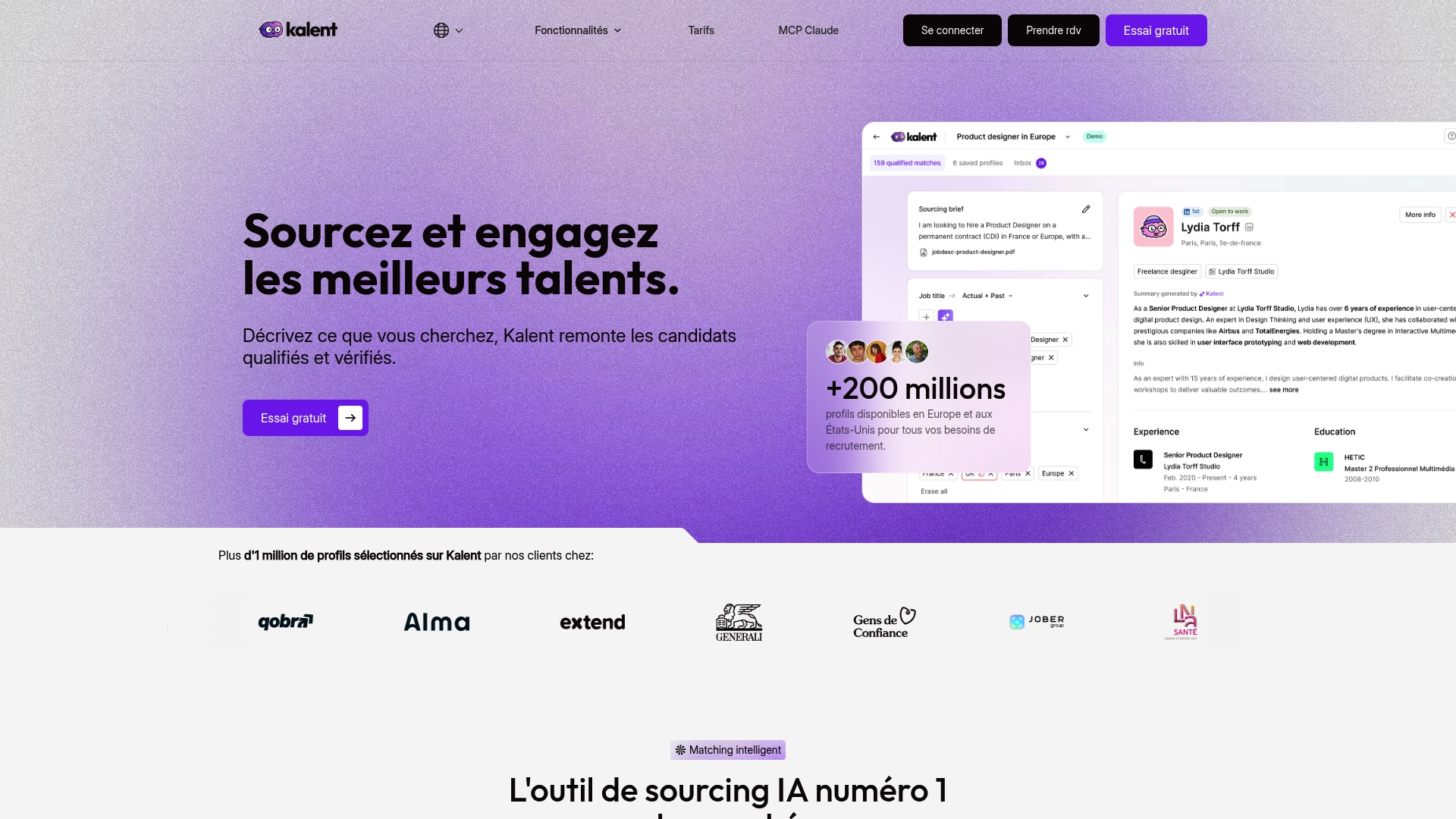
In practice, the talent search engine filters candidates without Boolean search, data enrichment provides the right contact details, and automated outreach via LinkedIn, email and WhatsApp follows up with profiles without waiting for a recruiter to think of it. This mechanism cuts sourcing time by 50 %, which frees up entire days to reinvest in interviews and decisions. Kalent integrates natively with tools such as BoondManager, to export qualified candidates straight into the existing HR pipeline. Pricing starts at €79 per month for the Sourcing plan; a demo lets you check whether the tool fits your current hiring volume.
Sources
- Executive hiring practices 2026 (APEC)
- How to set up an effective hiring process (Randstad France)
- France benchmark recruiting metrics (SmartRecruiters)
Frequently asked questions
What is the average time to hire?
The average time varies widely by role, but the latest executive hiring figure stabilizes around an average duration of several weeks in France, compared with a noticeably longer duration in some sectors, such as industry in industry. The median time to hire across all categories is close to a median of just over a month in France according to SmartRecruiters benchmarks.
Why does a recruiter take time to reply?
The delay rarely comes from the recruiter themselves, but from the availability of the internal decision-makers who must approve each step. A manager on the road or a committee that meets only once a week can add several days to a file that is already ready.
What are the key steps in a hiring process?
An effective process generally fits into four stages: clarifying the need and posting the offer, screening applications, interviews (ideally 2 to 3 according to the preferences expressed by executives), then the decision and the offer. The longest processes often add redundant steps that assess the same thing without realizing it.
What should I do if my hiring process is too long?
Start by measuring where the bottleneck really sits using your ATS: sourcing, first contact, or internal approval. A tool like Kalent can specifically reduce sourcing and first contact time, while a 72-hour internal SLA addresses bottlenecks tied to manager approval.


