Recruitment sourcing KPIs: the metrics that drive your results
Improve your hiring with five sourcing metrics (volume, response rate, conversion, time and cost) while staying compliant with the CNIL.

To manage sourcing and recruiting effectively, we recommend tracking five measurable indicators first: sourced volume, response rate, pipeline conversion rate, time-to-hire and cost per hire. These KPIs cover the talent pool, engagement, speed and budget, mainly as observed in French industry practice. One point of caution always applies: any processing of candidate data must comply with the framework set by the CNIL.
In short:
- For a small team, track the response rate, the application to interview conversion and the cost per hire every week for thirty days.
- A low rate between applications and interviews often signals a qualification problem, while a drop between interviews and offers reveals a gap in expectations.
- Compare the cost of each channel with its conversion rate: a cheap but inefficient source can cost more per hire than an expensive channel.
- Set consistent statuses and scopes, segment results by role, channel and experience, then update the dashboard every week.
- Any collection of candidate data must comply with CNIL rules, in particular informing the people concerned and the retention period.
Table of contents
- Essential sourcing KPIs: measuring the talent pool and engagement
- Conversion KPIs and pipeline management: assessing performance stage by stage
- Measuring cost and efficiency: cost per hire and channel ROI
- Quality and candidate experience KPIs: retaining hires and reducing turnover
- Building a KPI dashboard and standardizing calculations
- Operational example: tracking your KPIs with a sourcing tool
- Author's perspective: priorities for a modern recruiter
- Operational option: automating the collection of your sourcing KPIs
- Frequently asked questions
- Sources
Essential sourcing KPIs: measuring the talent pool and engagement
Sourced volume is the number of profiles identified and contacted over a given period, per recruiter or per role. Track it in a simple table, broken down by channel and by week, to avoid misleading spikes caused by a single campaign.
The response rate is calculated by dividing the number of replies received by the number of messages sent, and it varies widely depending on the channel used.
- LinkedIn: generally a lower rate but a qualified audience.
- Email: high volume, personalization is decisive.
- WhatsApp and phone: often higher rates thanks to the immediacy of the channel.
The average time to source a candidate is measured from the launch of the search to the first qualified contact. The hiring rate from proactive sourcing is obtained by dividing the number of sourced hires by the total number of profiles contacted.
French industry publications list these four indicators as the foundation of sourcing management. HelloWorkplace points out that absolute and relative KPIs should be combined to avoid false signals. When the response rate falls below a threshold considered low for the industry, the first action is almost always to rework message personalization rather than increase the volume sent.

Conversion KPIs and pipeline management: assessing performance stage by stage
The recruiting pipeline breaks down into successive stages, each measurable by its rate of progression to the next.
- The application to interview rate is calculated by dividing the number of scheduled interviews by the number of applications received; a low rate points to a qualification problem upstream.
- The interview to offer rate is obtained by dividing the number of offers made by the number of interviews held; a drop here often reveals a gap between the advertised role and the candidate's real expectations, which can be narrowed with an Ikigai coaching approach to align profiles and roles.
- The offer to hire rate measures accepted offers among offers made; a poor rate signals a problem with the package, decision time or competition between employers.
- The hiring rate by source compares the share of hires generated by each channel, which helps decide between job boards, employee referrals and direct sourcing.
Pipeline speed is tracked by measuring the time spent at each stage: a bottleneck shows up when one stage takes abnormally long compared with the others. Employee referrals generally convert better than job boards, which justifies tracking them as a separate channel in management dashboards.
Measuring cost and efficiency: cost per hire and channel ROI
Cost per hire adds up direct expenses (job ad distribution, tool subscriptions, agency fees) and a share of internal costs (recruiter time, interviews, onboarding), divided by the number of hires made over the period.
- Direct costs: distribution, software licenses, external services.
- Indirect costs: time of the HR teams and managers involved in the process.
- Cost per channel: the same formula applied to a single channel, to compare job boards, professional networks and employee referrals.
Cost per channel becomes more relevant when cross-checked with the conversion rate of that same channel: a cheaper channel that converts poorly can end up more expensive than a premium but effective one. This combined reading guides budget decisions better than an isolated raw cost.
Quality and candidate experience KPIs: retaining hires and reducing turnover
The offer acceptance rate is calculated by dividing accepted offers by offers made, and it is worth cross-checking with the stated reasons for refusal (pay, timing, counteroffer).
- Candidate NPS is measured with a short survey sent after the process, whatever the outcome.
- Turnover at 3, 6 and 12 months assesses the real strength of a hire beyond the signature itself.
- Onboarding indicators (completion rate of the onboarding program, time before the first review) round out the quality picture.
The CIPD 2026 report observes that organizations that regularly measure time-to-hire and candidate experience spot their friction points faster and improve their offer acceptance rates.
Pro tip: Send the candidate satisfaction survey within 48 hours of the final decision, accepted or declined, to capture a response while it is fresh.
Building a KPI dashboard and standardizing calculations
A reliable dashboard starts with a fixed scope: the same comparison period (month over month or quarter over quarter), the same job families, the same pipeline statuses. Normalizing candidate statuses (contacted, shortlisted, interview 1, offer, hired) is a condition for reliable KPIs; without it, comparisons between recruiters or periods lose their meaning.
| KPI | Formula | Worked example |
|---|---|---|
| Response rate | Replies ÷ Messages sent | 25 replies ÷ 100 messages = 25% |
| Application → interview rate | Interviews ÷ Applications | 10 interviews ÷ 50 applications = 20% |
| Cost per hire | Total costs ÷ Hires | €15,000 ÷ 5 hires = €3,000 |
| Offer acceptance rate | Accepted offers ÷ Offers made | 8 accepted offers ÷ 10 made = 80% |
Segmenting by role, by channel and by experience level avoids mixing different realities into a single average. A weekly update is enough for operational management, with alert thresholds defined in advance for each indicator.
Operational example: tracking your KPIs with a sourcing tool
A sourcing engine can automate part of this data collection, which reduces manual reporting work. Tracking sourced volume and response rate by channel can be fed directly from outreach campaigns run on LinkedIn, email and WhatsApp.
- Sourced volume and response rate by channel flow in automatically from outreach campaigns.
- Exports integrate with ATSs such as BoondManager to feed a normalized dashboard.
- Any processing of candidate data remains subject to the obligations set out by the CNIL, in particular informing the people concerned and the retention period.
This automation does not replace human analysis: it frees up time to interpret gaps and adjust the sourcing strategy.
Author's perspective: priorities for a modern recruiter
A small team is better off starting with just three KPIs: response rate, application to interview conversion rate, and cost per hire. Over thirty days, tracking these three numbers every week is enough to spot what matters. A more mature team can add candidate NPS and three-month turnover. The signal that calls for immediate action is the same at any scale: an offer acceptance rate that falls over two consecutive periods.
Jules
Operational option: automating the collection of your sourcing KPIs
Part of the time spent managing these indicators disappears once sourcing itself is automated.
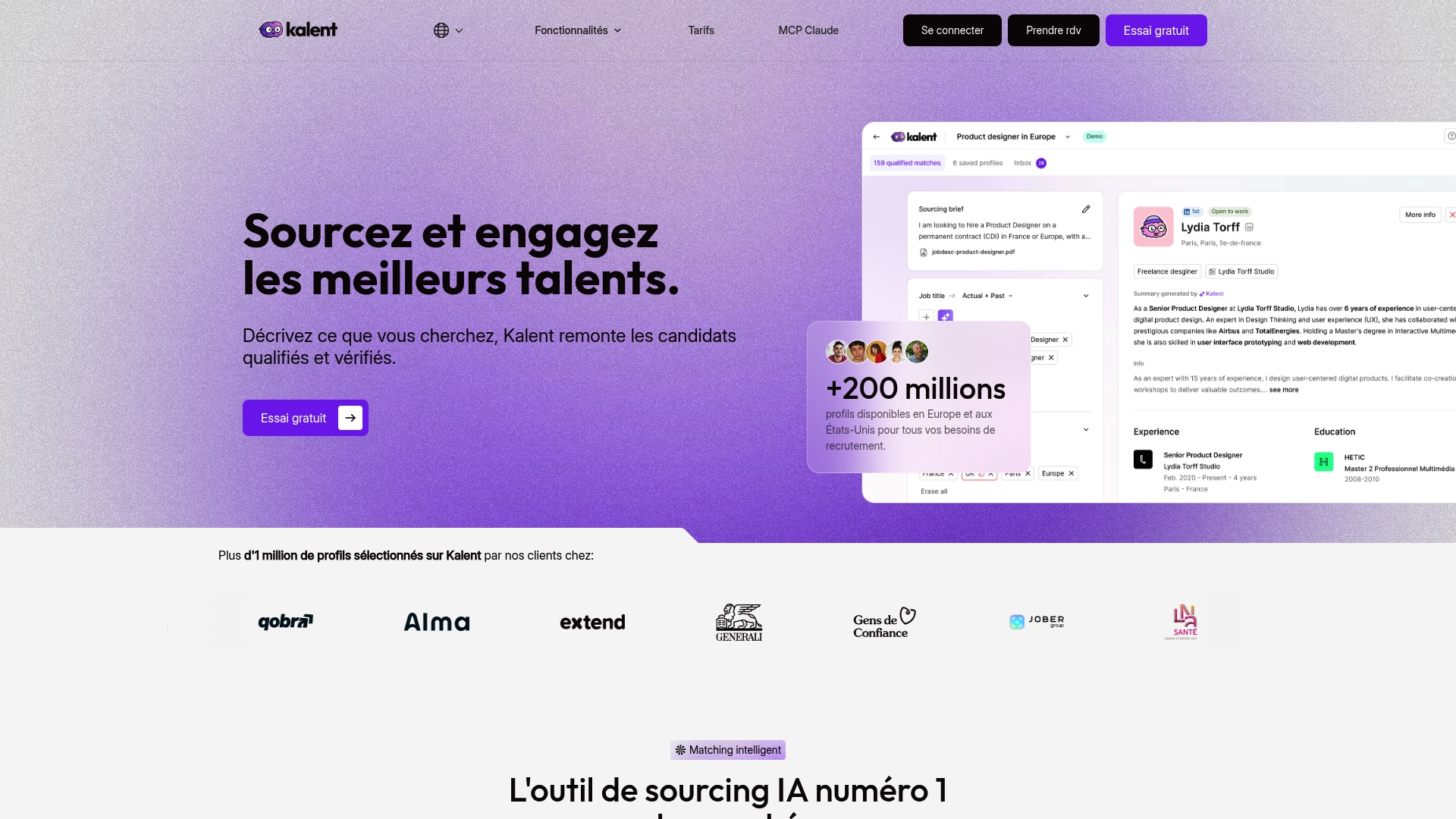
- Search and filtering of qualified profiles across a pan-European and US database.
- Automated multichannel outreach (LinkedIn, email, WhatsApp) to generate response rate data continuously.
- Direct export to ATSs to feed a normalized dashboard.
| Plan | Price | Link |
|---|---|---|
| Sourcing | Current prices are available on the pricing page | See pricing |
| Copilot | Current prices are available on the pricing page | See pricing |
The return on investment becomes visible as soon as the sourcing time saved exceeds the cost of the subscription, a calculation detailed in our method for calculating the ROI of a sourcing tool. For teams that want to test automated collection of these KPIs, our sourcing platform offers a trial.
Frequently asked questions
What is the main purpose of recruiting KPIs?
A recruiting KPI turns an impression ("sourcing is slow") into a number that can be compared over time, which makes it possible to detect a specific problem and act on it. The goal is not to pile up measurements, but to keep a small number of indicators tied to an operational decision.
How long does a hire take on average?
Rather than relying on a single figure, it is better to measure your own time-to-hire by job family, as detailed in our guide to time to hire.
What is sourcing in recruiting?
Sourcing is the proactive process of identifying and reaching out to candidates who have not responded to a job posting, as opposed to handling inbound applications. It relies on a variety of channels: professional networks, profile databases, employee referrals or direct approach.
What is another word for KPI?
In French, KPI translates to "indicateur clé de performance", often abbreviated as ICP. Both terms mean the same thing: a quantified measure tied to a specific recruiting or sourcing objective.
Sources
- Resource and talent planning report 2026
- Le guide du recrutement | CNIL
- KPI recrutement | HelloWorkplace