
How to Calculate the ROI of a Sourcing Tool: Method and KPIs
Calculate the ROI of a sourcing tool: convert hours saved into annual savings, and lower your cost per hire and time-to-hire.

The ROI of a sourcing tool is measured mainly as net annual savings: recruiter hours saved multiplied by the hourly cost, translated into a lower cost per hire and a shorter time-to-hire. This metric speaks to finance as much as to recruiters. FranceTravail's 2025 hiring intentions, the CNIL's recommendations and the practices observed by APEC make it possible to build a solid calculation from the very first evaluation.
In short:
- The value of a sourcing tool depends mainly on the recruiting hours it saves, especially for hard-to-fill or critical roles.
- A simple ROI calculation relies on the reduction in sourcing time multiplied by the hourly cost, minus the annual cost of the tool, to be verified with a pilot beforehand.
- GDPR compliance must be built into the ROI calculation, with an initial audit, regular monitoring, and checks that data retention rules are respected.
- Sourcing performance is also measured with KPIs such as time-to-hire, cost per hire or acceptance rate, tracked in a quarterly report.
- It is crucial to pilot the tool before a large-scale purchase, to test its results against your real hiring volume and so limit the risk of a fictitious ROI.
Table of contents
- Why measure ROI, and when a tool becomes strategic
- A simple formula and a worked example to calculate the ROI of a sourcing tool
- Essential KPIs to link sourcing and recruiting performance
- How to build CNIL compliance into the ROI evaluation
- Case study: turning Kalent's evidence into ROI variables
- Actionable checklist before buying and for running the pilot
- Analysis of the hidden costs of implementing and maintaining a sourcing tool
- How integrating the tool with existing systems affects ROI
- Assessing the risks of a sourcing tool
- Expert perspective: when an ROI is convincing enough
- Direct option: how Kalent can help prove ROI
- Sources
- Frequently asked questions
Why measure ROI, and when a tool becomes strategic
A sourcing tool does not deliver the same value on every role. For rare or technical jobs, the time saved identifying qualified profiles weighs heavily in the financial calculation. FranceTravail reports that around 50% of the hires planned in 2025 are considered difficult by employers, which shifts the value of a sourcing tool toward roles under talent shortage rather than standard roles where the talent pool is plentiful.
Two types of gains coexist, and they must be told apart before any calculation:
- Tangible gains: sourcing hours saved, lower cost per hire, shorter time-to-hire.
- Intangible gains: better candidate experience, responsiveness as perceived by hiring managers, stronger employer brand.
The purchase becomes a priority for critical roles, high hiring volumes, or when leadership asks for faster hiring decisions.
A simple formula and a worked example to calculate the ROI of a sourcing tool
The calculation fits in a short formula that any recruiter can reproduce in a spreadsheet before presenting it to a committee:
- Add up the sourcing hours saved over a month and multiply them by the recruiter's fully loaded hourly cost.
- Subtract the annual cost of the tool, subscription and integration included, from this annualized total.
- Divide the result by the annual cost of the tool to get the ROI ratio.
The variables to collect before running the calculation are simple: hours saved per hire, average recruiter hourly cost, pipeline-to-hire conversion rate, subscription cost and technical integration cost.
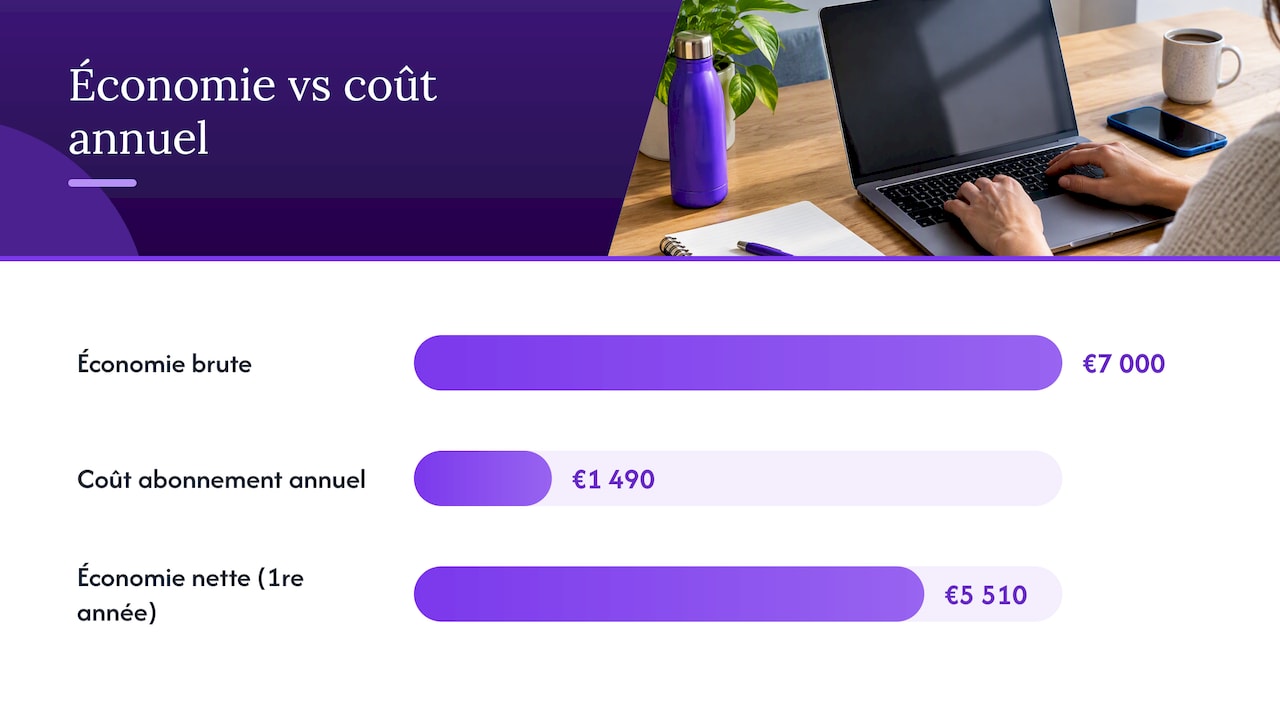
Let's take an illustrative example for a team of three recruiters. Say a recruiter spends 10 hours per hire on manual sourcing and the tool cuts that time to 5 hours, so 5 hours saved per hire. With a fully loaded hourly cost of 35 euros and 40 hires a year, gross savings reach 5 × 35 × 40, or 7,000 euros. If the annual subscription costs 1,490 euros (Kalent's Sourcing plan), net savings come to 5,510 euros, for an ROI of 370% in the first year.
The use of AI in recruiting remains marginal, with only 4 to 8% of executive hires integrating it directly according to APEC, which leaves clear room for progress for teams that structure their ROI calculation now.
Essential KPIs to link sourcing and recruiting performance
A credible ROI relies on indicators tracked over time, not on a one-off calculation. The KPIs to include in monthly reporting are the following:
- Time-to-fill measures the time between opening the role and signing the contract.
- Time-to-hire measures the time between the first candidate contact and the offer acceptance.
- Cost per hire adds up sourcing, tool and recruiter time costs, divided by the number of hires.
- Cost per qualified candidate isolates sourcing performance before the interview even takes place.
- Offer acceptance rate and hiring manager satisfaction measure pipeline quality.
- Retention rate at 6 and 12 months confirms that hiring speed has not degraded the quality of hires.
Pro tip: Build a quarterly dashboard with these six indicators rather than an exhaustive monthly report: the trend matters more than one-off variation.
An external guide on recruitment tracking indicators details ten complementary KPIs for teams that want to refine their management beyond these six core metrics.
How to build CNIL compliance into the ROI evaluation
Complying with data protection rules is not just an extra cost, it is a financial risk factor too often left out of the ROI calculation. The CNIL's recruitment guide sets precise requirements: a defined purpose for collection, minimization of the data gathered, clear information for candidates and limited retention periods. Sourcing on the internet and social networks falls fully within this scope.
Before signing a contract with a sourcing tool vendor, plan for these cost and control items:
- An initial audit of the database and where it comes from.
- A contractual clause on the retention period and deletion procedures.
- Time from the data protection officer or an external legal advisor.
- A periodic check that candidates' rights of access and rectification are respected.
A simple compliance indicator, in the form of a score out of 100 points covering these four criteria, makes it possible to include regulatory risk in reporting without weighing down operational tracking.
Case study: turning Kalent's evidence into ROI variables
The information shared by the vendor Kalent illustrates how a sourcing tool can weigh in an ROI calculation.
Back to the previous example: if manual sourcing took 10 hours per hire, cutting it in half brings that time down to 5 hours, the exact gap used in the ROI calculation in the previous section. Over 40 hires a year and an hourly cost of 35 euros, that represents the 7,000 euros of gross savings already calculated.
- These figures are vendor claims, not independently measured results.
- They must be verified in a pilot before being included in a final business case.
- GDPR compliance of the enriched data must be validated before any large-scale rollout.
Pro tip: Always ask for a 30 to 60 day pilot before signing an annual contract, to test the announced figures against your real hiring volume.
Actionable checklist before buying and for running the pilot
Before investing in a sourcing tool, eight checks help secure the decision and avoid a theoretical ROI that never materializes:
- Establish a quantified baseline of current sourcing time and cost per hire.
- Set measurable 90-day objectives, not vague intentions.
- Select one to three pilot roles representative of your real volume.
- Collect the fully loaded hourly cost of each recruiter involved.
- Check the tool's compatibility with your existing ATS.
- Have your data protection officer validate GDPR compliance.
- Define a quarterly reporting plan with the chosen KPIs.
- Set clear success thresholds before launching the pilot.
Involve the DPO from the selection phase, hiring managers to validate the perceived quality of profiles, and finance to approve the ROI calculation before the wider rollout.
Analysis of the hidden costs of implementing and maintaining a sourcing tool
The listed subscription price is only part of the real cost. Implementation takes internal time: configuring search criteria, training recruiters, creating message templates for multichannel automation. This setup time, often underestimated, must be costed just like the hours saved afterward.
Maintenance adds a second layer of costs. Candidate databases need regular updates to stay relevant, and a platform that does not refresh its profiles sees its value erode over time. Technical support, feature changes and any additional integration fees with new internal tools come on top of the initial annual cost.
An often forgotten item: the cost of switching tools if the solution does not fit. Migrating candidate data, retraining teams and losing continuity during the transition are a real cost best anticipated before signing, for example by negotiating a short commitment period or a simplified exit clause.
To limit these hidden costs, ask the vendor for a precise estimate of average implementation time and check whether team training is included in the subscription or billed separately.

How integrating the tool with existing systems affects ROI
A sourcing tool that works in a silo, disconnected from the ATS and the recruiting CRM, creates double data entry that cancels out part of the expected time savings. Technical integration directly determines whether the ROI calculated on paper materializes.
When qualified profiles are exported automatically to the ATS pipeline, the recruiter saves the time they would have spent manually copying contact details and application statuses. Conversely, a missing or partial integration forces teams to juggle several interfaces, which dilutes the time savings announced by the vendor.
Before signing, check the list of ATS and CRM tools natively compatible with the tool under consideration, and ask for a concrete demonstration of the data flow between the two systems rather than a simple verbal confirmation of compatibility. A native integration also reduces the risk of data entry errors and improves application traceability, a point that matters as much for GDPR compliance as for operational performance.
Assessing the risks of a sourcing tool
Three risks frame the evaluation of a sourcing tool before purchase: technical availability, functional obsolescence and vendor dependency.
A prolonged outage of a sourcing platform blocks access to profiles and to outreach automations, with a direct effect on the ongoing hiring pipeline. Ask the vendor for its availability commitments and incident procedures before rolling out usage to the whole team.
Functional obsolescence affects tools that do not evolve their search engine or candidate database. A platform that does not regularly update its profiles sees its rate of valid contacts decline, which degrades the ROI initially calculated.
Vendor dependency deserves particular attention: the more deeply the tool is integrated into your processes, the higher the exit cost if you are dissatisfied. Negotiating a reasonable commitment period and checking the export conditions for collected data limits this risk before it becomes a blocker.
Expert perspective: when an ROI is convincing enough
An ROI becomes indisputable when three conditions come together: the targeted role is rare or critical, net savings far exceed the cost of the tool over twelve months, and GDPR compliance has been verified before rollout. Below these thresholds, the investment remains a bet rather than a quantified decision.
Keep the evidence behind the decision (initial baseline, tracked KPIs, compliance score): it forms the foundation of a solid business case for leadership.
Jules
Direct option: how Kalent can help prove ROI
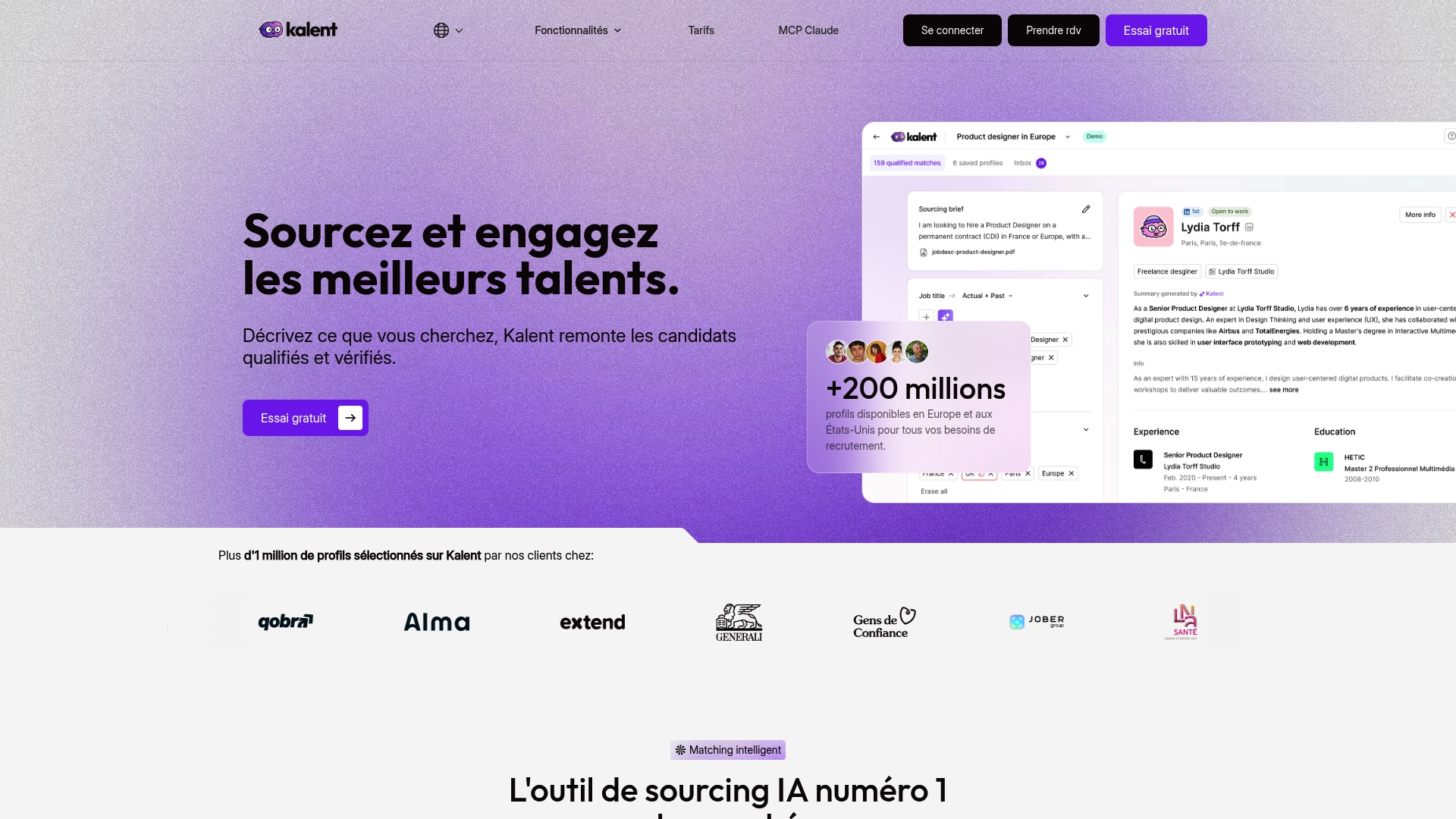
Building a solid ROI calculation requires reliable data, and that is exactly what Kalent brings to recruiters looking to cut their sourcing time without multiplying tools. The platform combines a talent search engine covering more than 200 million enriched profiles, an 80% access rate to mobile numbers and 60% to personal emails, and outreach automation via LinkedIn, email and WhatsApp managed from a single dashboard.
Kalent offers a personalized demo to assess, role by role, the realistic time savings before any commitment. Plan and pricing details are available on the pricing page. Book your demo to build your own ROI calculation on your priority roles.
Sources
- CNIL: Le guide du recrutement (recruitment guide)
- FranceTravail: Intentions d'embauche 2025 (2025 hiring intentions)
Frequently asked questions
How do you calculate the ROI of a sourcing tool simply?
Subtract the annual cost of the tool from the net savings generated by the sourcing hours saved, then divide the result by the annual cost of the tool. This formula gives a ratio that finance leadership can understand right away.
Which KPIs should you track first to justify an investment?
Time-to-fill, cost per hire and offer acceptance rate form the minimum foundation to track every quarter. Adding the six-month retention rate confirms that hiring speed has not hurt the quality of hires.
Does GDPR compliance really affect the ROI calculation?
Yes, because insufficient control over data provenance or retention periods creates a financial and regulatory risk that must be included in the overall calculation. The CNIL's recruitment guide details the minimization and information requirements to meet.
How much does a sourcing tool like Kalent cost?
Kalent offers a Sourcing plan at 79 euros per month or 1,490 euros per year, and a Copilot plan at 119 euros per month or 1,790 euros per year, according to the pricing page. A Team plan is also available, with pricing on request.
Should you test a sourcing tool before buying it at scale?
A 30 to 90 day pilot on one to three representative roles lets you test the gains announced by the vendor against your real hiring volume. This step limits the risk of a theoretical ROI that does not materialize once the tool is rolled out to the whole team.


