
Time to hire: how to measure it and reduce it for good
Measure time to hire precisely, use the median, aim for 20 to 30 days, and segment your funnel by stage when the delay goes past 40 days.

Time to hire measures the number of days between a candidate's first contact with your process (application or sourcing) and their acceptance of the offer. A well equipped company generally aims for 20 to 30 days; past 40 days, it becomes urgent to segment the funnel stage by stage to identify where the delay builds up.
In short:
- If your recruitment process goes past 40 days, it is crucial to segment each stage to identify the bottlenecks and act quickly.
- The median time to hire in Europe is around 40 days, but an effective structure can bring that delay below 22 days.
- The delay between the application or the first contact and the acceptance of the offer must be measured by job family, not as a global average, to get a precise view.
- Shortening sourcing and automating follow ups can cut the initial delay in half, often the longest phase of the process.
- You also need to track complementary indicators such as the offer acceptance rate and candidate satisfaction for precise recruitment steering.
Table of contents
- How to define precisely and calculate time to hire
- Why you should distinguish time to hire from time to fill
- Which benchmarks should you aim for depending on the type of role?
- How to instrument the recruitment funnel to segment the delay?
- Bottleneck diagnosis: where is the time really lost?
- Which levers should you pull to reduce the delay in 30 and 90 days?
- Which KPIs should you track and how do you translate the delay into cost?
- What recent studies show about time to hire
- Controlled speed: my take on the speed versus quality balance
- Speeding up sourcing without sacrificing the quality of profiles
- Sources
- Frequently asked questions
How to define precisely and calculate time to hire
The formula is simple on paper: the offer acceptance date minus the date the candidate entered the process. The tricky part is setting that starting point. For a candidate who applies spontaneously, you start at the application. For a profile sourced by a recruiter, you start at the first effective contact, not at the opening of the role.
Take a concrete example: a backend developer contacted on 3 March, who has a first interview on 12 March, receives an offer on 28 March and accepts it on 2 April. The time to hire is 30 days.
- Use the median rather than the average: a few very long hires (executive roles, rare profiles) distort the average and hide what actually happens on the ground.
- Always calculate by job family, never a single figure for the whole company.
Why you should distinguish time to hire from time to fill
Time to fill measures the delay between the opening of a role and the day the selected candidate actually starts working, whereas time to hire starts at the candidate's first engagement and stops at the acceptance of the offer. The two answer different questions.
- Time to fill includes the phase of defining the need and the candidate's notice period, two elements outside the recruiter's control.
- Time to hire isolates the real performance of the recruitment process: sourcing, interviews, decision.
If your goal is to assess overall HR planning, track time to fill. If you want to steer the day to day efficiency of your recruitment team, time to hire remains the most actionable indicator.
Which benchmarks should you aim for depending on the type of role?
The average time-to-hire in Europe sits at around 40 days, but companies that have structured their process often come down to 20 or 22 days within that same panel. The gap between those two figures is not anecdotal: it represents nearly three weeks of difference on an open role.
Key figure: a French study covering more than 200 hires shows a median of 76 days when managed internally, against 28 days when the process goes through an RPO provider specialised in technical roles.
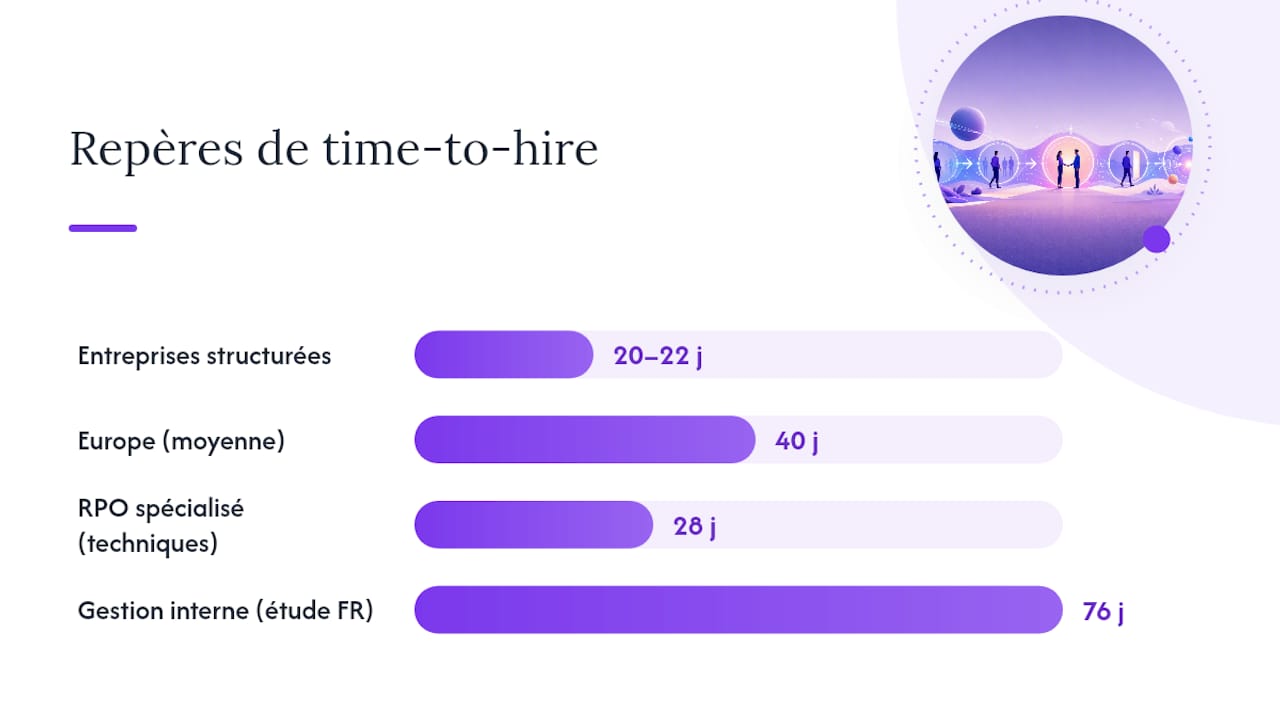
Public sector data, such as the figures from the BMO survey, helps calibrate these benchmarks job by job rather than relying on a national average that poorly represents your sector.
These figures remain points of comparison, not universal targets. An engineering firm and a retail chain do not have the same pool of available candidates, and copying a target delay without accounting for your local market produces more frustration than progress.
How to instrument the recruitment funnel to segment the delay?
Overall time to hire says nothing about where the time is lost. To find out, you have to track each stage separately.
- Date of entry into the process: application received or first sourced contact.
- Date of first recruiter contact: qualification call or reply message.
- Date of first interview: with the recruiter or directly with the manager.
- Date of internal decision: approval or rejection by the hiring committee.
- Date the offer was sent.
- Date of acceptance.
Once those dates are captured in your ATS, prioritise the median and the p25/p75 percentiles per stage rather than the global average alone: this approach reveals the outliers that pull the delay upwards far better. Then segment by department, contract type (permanent, fixed term, apprenticeship) and recruiter in charge, because the gaps between teams are often more revealing than the company average.
Pro tip: Do not stop at the average time per stage. Look at the variance: a manager who approves in 2 days one month and in 15 days the next reveals real organisational friction, not just workload.
Bottleneck diagnosis: where is the time really lost?
Comparing durations by stage and by department lets you locate the problem before acting. Slow sourcing and a slow internal decision are not cured with the same levers.
- If the delay between application and first interview goes past 10 days, sourcing or CV screening is probably the bottleneck.
- If interviews follow one another quickly but the offer is slow to come out, the problem comes from managerial approval, not from recruitment.
- A very high interview to offer ratio (many interviews for few offers issued) signals badly calibrated criteria upstream.
- An abnormally long manager delay on certain decisions, compared with others, points to the need for a clear internal SLA.
These signals are easy to read once the funnel is segmented: they point directly to the action to prioritise rather than to a generic plan.
Which levers should you pull to reduce the delay in 30 and 90 days?
Some actions produce a fast effect, others require a deeper overhaul of the process. Here is how to rank them.
- Weeks 1 to 4: the quick wins. Automate interview scheduling to eliminate the back and forth by email, create offer templates approved in advance by managers, and set up automatic follow ups for candidates who have not replied within 48 hours.
- Months 2 to 3: the structural changes. Set a managerial approval SLA (for example 48 hours maximum to approve or reject a candidate after an interview), centralise the pipeline in a single tool visible to the whole team, and build a pool of already qualified candidates for recurring roles.
- Beyond 90 days: the technologies to evaluate. Sourcing powered by AI speeds up the identification of qualified profiles, an automated scheduling agent reduces coordination delays, and a native integration with your ATS eliminates the double entry that slows down every transition between stages.
Companies that centralise their pipeline and automate interview coordination see significant reductions in their time-to-hire, which confirms that most of the gain often comes from organisation before technology even enters the picture.
Pro tip: Always start with the lever that costs the least and pays off the fastest: a clear manager SLA costs zero euros and can save a full week on certain roles.
For a more detailed list of operational tactics, see our checklist of 10 effective ways to reduce time to hire.
Which KPIs should you track and how do you translate the delay into cost?
Time to hire alone is not enough to steer a recruitment team. You have to surround it with complementary indicators and with a translation into cost to convince managers to act.
- Time to first interview: the delay between application and first interview, a good indicator of sourcing speed.
- Offer acceptance rate: a drop often signals a time to hire that is too long and drives the best profiles away.
- Candidate satisfaction (NPS): a long process almost always degrades the experience, even for the candidates who are hired.
Key figure: an open role often costs between 30 and 80 € per day depending on the sector, in lost productivity and in the workload shifted onto the existing teams. Multiplying that figure by the number of days of delay turns an abstract HR indicator into a concrete budget argument for operational leadership.
Set an alert threshold (for example, any hire going past 45 days triggers a review) and a monthly rather than quarterly follow up cadence, so you can step in before the delay builds up across several roles.
What recent studies show about time to hire
The available data converges on one point: how the process is structured counts more than the size of the company. In France, recent sector analyses show that companies dragging on their delays lose candidates to faster competitors in the same talent pool.
Reducing time-to-hire serves no purpose if it degrades the quality of the hires. The goal remains a balance between the speed of the candidate process and the rigour of the decision.
This warning, which comes from the analyses of Greenhouse, deserves to be taken seriously: a record delay obtained by skipping approval stages often costs more in turnover than the opposite. The RPO studies cited above cover a sample limited to certain technical sectors; they indicate a solid trend, not a universal guarantee applicable to every job.
Controlled speed: my take on the speed versus quality balance
Speed only has value if it eliminates useless friction, not steps of judgement. A manager SLA or automated scheduling removes dead time; skipping a framing interview removes reliability. My priority for the first 90 days: instrument the funnel before optimising, otherwise you may well be speeding up the wrong stage.
- Jules
Speeding up sourcing without sacrificing the quality of profiles
One of the most concrete levers for reducing time to hire is shortening the sourcing phase itself, the one that often weighs the heaviest even before the first interview.
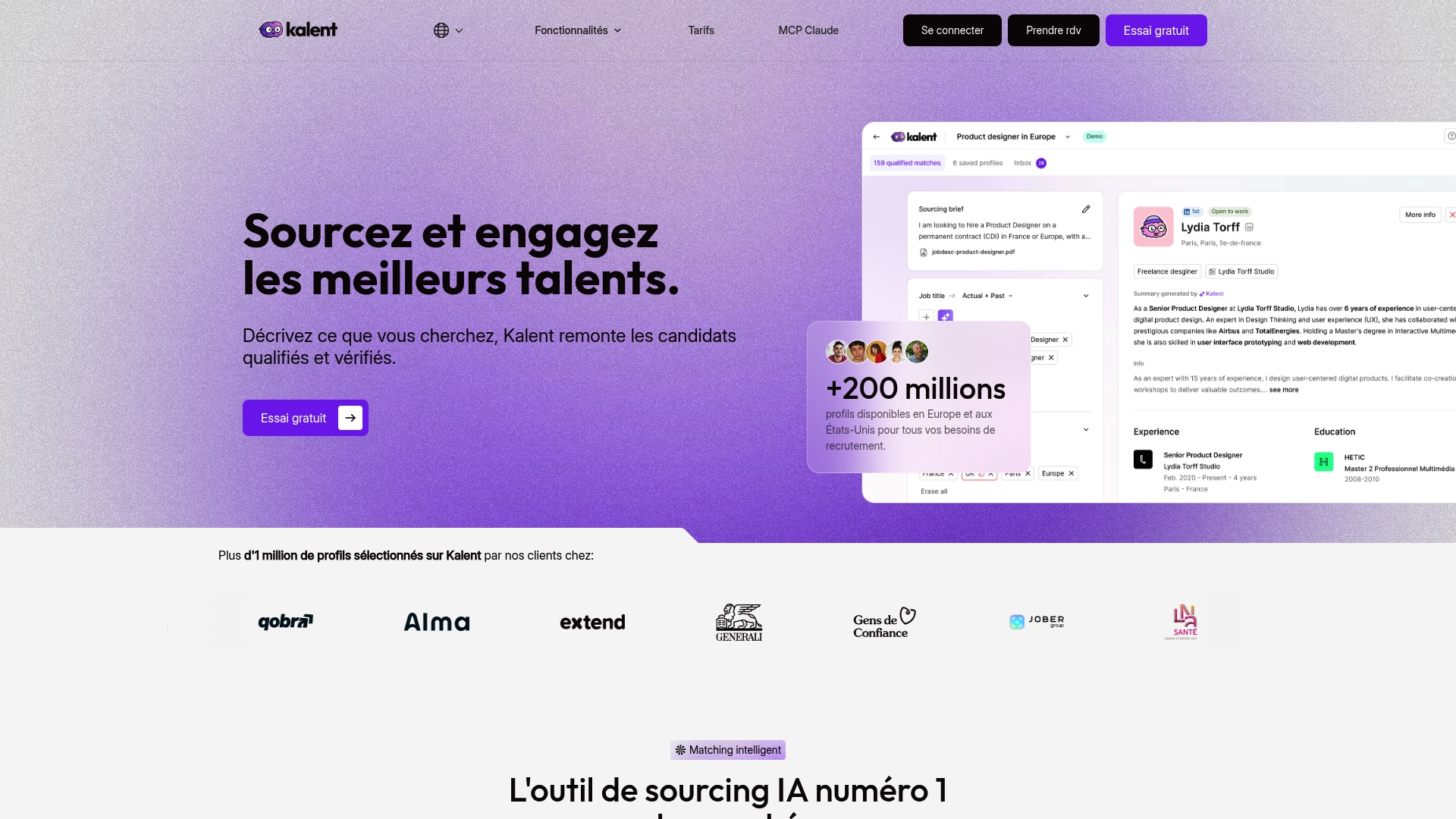
Contact data enrichment lets you follow up with a sourced candidate in a few minutes rather than several days, and automating follow ups through LinkedIn, email and WhatsApp cuts sourcing time in half. For a recruitment team looking to compress the first part of the funnel, often the longest, that is a direct gain on overall time to hire, without going through an external provider. Book a demo to see how Kalent fits into your current process.
Sources
- Time to Hire vs Time to Fill: Two Recruiting Metrics, Two Very Different Questions | MangoApps
- Time-to-hire in Europe: the 2026 benchmark
- Average time-to-hire France 2026, study of 200+ hires | Rocket4RPO
- What is time-to-hire? | Greenhouse
Frequently asked questions
What are the 4 key stages of recruitment?
A classic recruitment process covers sourcing, pre-selection (CV screening and qualification interviews), the decision interviews with the manager, then the offer and the negotiation up to acceptance.
Why does a recruiter take so long to reply?
The delay rarely comes from the recruiter themselves: it often reflects the wait for a managerial approval, a high volume of applications to screen, or an internal process that has no defined response threshold.
What is the average time for a hire?
The average time-to-hire observed in Europe is around 40 days, but it often comes down to 20 or 25 days for companies whose process is well structured and well equipped.
Which tool should you choose to reduce your hiring delay?
A sourcing platform like Kalent speeds up the longest phase of the funnel by giving direct access to the contact details of candidates, while a well configured ATS helps measure and segment the delay at each following stage.


